continuing the journey …

BAgAPwiCQAA-dzEthe gathering got together today for what has become a bit of a tradition for our first service in the new year. A tradition that sees us consider the Christian Journey and wonder where we are with God and ourselves at this particular time.

If you have not seen or experienced ‘the journey’ I have blogged about it before here and in other blogs. Essentially the journey is an exercise where we get to think about where we currently are in our Christian life. The Christian life, we believe, is full of different experiences that happen over and over again. In our particular journey we have:

the mountain top : experiences where the air is clear and where you feel close to God with renewed vision, lots of energy and stuff. Mountain top experiences are great, you can see the rest of the journey before you and have a great sense of where everything is heading, but you can’t live here for long, nothing grows and the air is then so soon you have to come down.
the valley: this path often follows a mountain top experience. The sides of the valley are high, the valley is narrow and dark and sometimes you need to trust what you sw from the mountain and keep walking.
rivers cross the path unexpectedly. These can be times of refeshment or simply playing the water. You can choose to take a bridge over them or play or drink from them awhile.
the desert … a place where often you can feek disconnected from God, or disorientated. This is not really an enjoyable place and sometimes we can feel we may even be losing faith. The deset is a harsh place, but from scripture we also know it can be a place of preparation.
lakes are places where we can wallow, rest, and simply chill with God. AS we chill sometimes we find our vision develops.
the sea …. a place where you can walk out, beyond your depth, and simply let the sea of God take you where it will. This can often involve  a step of faith of varying magnitude.

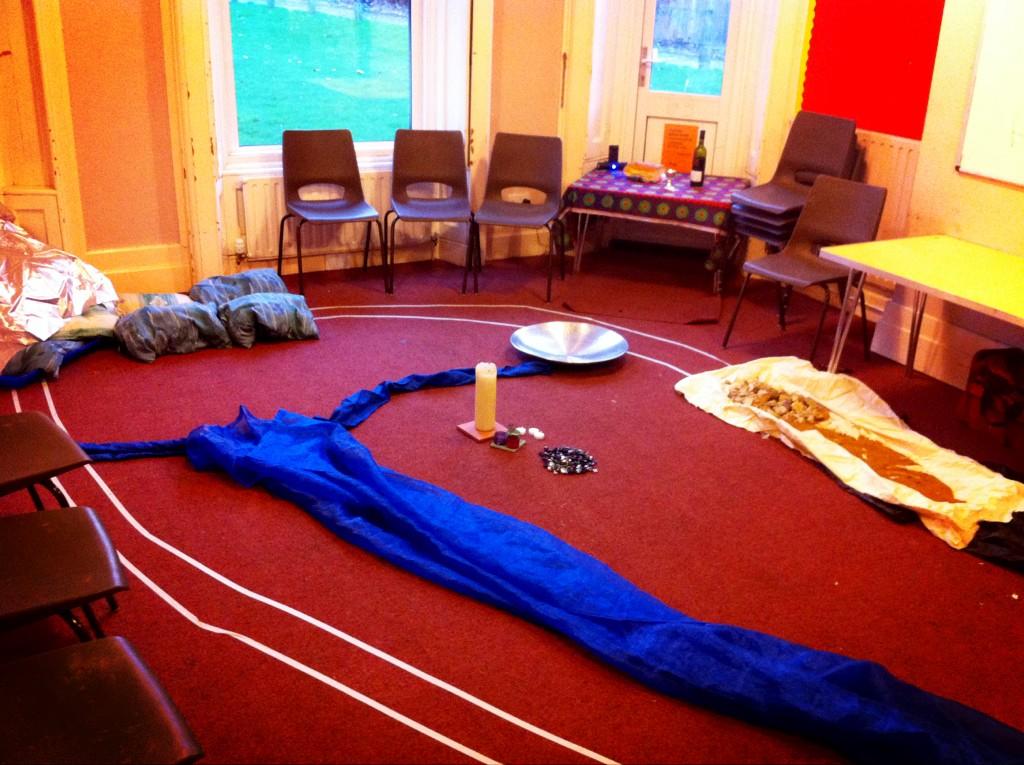
The image shows what our journey looked like today. After a brief introduction people of the gathering took glass beads and placed them where they thought they were on the journey today. Many of us felt that elements of our lives were in different places on the journey and so we placed a number of bead around different locations. Personally I felt I was in the rocky desert and in the shallows of the sea. Others were on mountain tops, in valleys, in lakes, deserts ….. members of the gathering were scattered around the whole journey. The exiting thing I find about the journey each time I do it with a group of people is that we are all at different places at different times, but we are all on a journey. Each of these places is valid and correct, there is no wrong place to be … all is sacred because all is with God! Often we fall into the trap at looking at where others are and wishing we could be with them or be like them, when, actually, we are where we are with God and that is the right place.

I quoted Vesey in Developing Consciousness last year, and his writing is apt following our gathering today:

You are always in exactly the right place to be able to take the next step.
It is an amazing realisation, that you are, right now, in exactly the right place to begin this journey.
Your whole life has brought you to this point. Everything you have ever done has brought you to the point of reading these words now. And everything has conspired for you to be in exactly the right place. You could not be in a better place.
And that is true for every single moment of your life.
You are never in the wrong place. All you can do is to not recognise you are in the right place, and then automatically you miss the point and opportunity of that moment.
To be in the right place at the right time you simply have to acknowledge  the rightness of the moment, and thus the moment become yours.
Do it now, without qualification.
Whatever our circumstances, wherever you are. Trust this moment as being one that is right. One that has meaning. One that is setting you on a journey outside the box, and it will be so. And what is the next step? Well … ask yourself that …. what is the next step? What do you do right now as the next step?

The gathering then concluded our time together by sharing communion and saying the Methodist Covenant Prayer together …. if you don’t know it go and have a read, it’s a pretty amazing thing to pray.

Thank you people of the gathering fro making today a pretty special experience …. her’s to continuing the journey …
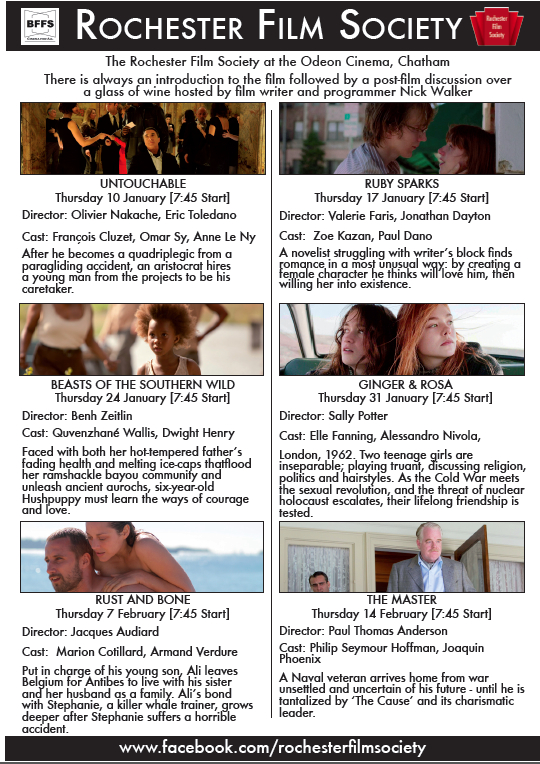
great lineup …

rochester film society

… from Rochester Film Society for this term.
Why not join us tonight, or any other Thursday to watch some great films and have a great chat afterwards with some great people …. oh and with beer!

are we ready to … Ask Seek Knock

ask-seek-and-knockAsk …. seek …. knock.
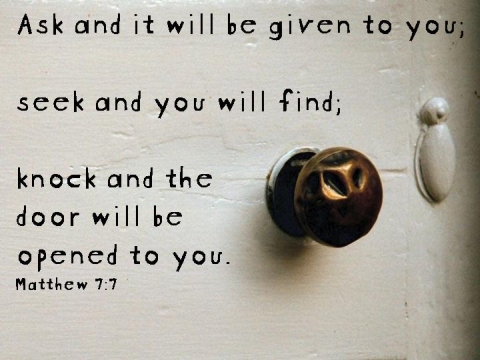
Ask and it will be given to you.
Seek and you will find.
Knock and the door will be opened.

These words of Christ that have been both a comfort and a challenge to me over the years. It would seem that now, though, they are becoming increasingly more of a challenge than a comfort. It is easy to run these words off to ourselves and others as an indication of a warm comfortable promise but, on both a personal and ministry level, I am finding the warm comfort has shifted to allow more of the hot prodding poker of a challenge.

As I think around, and reflect upon, these words of Christ I am discovering that these words of Christ demand a certain level of authenticity from me. They demand an authenticity in understanding that there is no point in asking if you think you already know the answer. An authenticity that refuses to seek or search for something  if you are not prepared to accept, and act upon, what you find. An authenticity that will not knock on the door until you are willing to step inside, and stay awhile, should you be invited.

I have come across quite a few people, over the last few months, who are struggling with faith, truth and life. They are experiencing stuff that is not compatible with their current belief system or developed faith. I wonder, though, whether they are actually struggling with faith as such, or whether they are struggling more with their discoveries from their asking, their seeking and their knocking.

You see, this lifestyle of question (ask), explore (seek) and introduction (knock) can cause us problems. Only the other day a Christian friend asked me about some issue that they feel they cannot raise in their church because the very raising, or asking, would bring a negative reaction. I believe this is why pub theology, a safe and accepting place to question and explore, has worked so well.

If what we believe is the truth then it will, stand up to re-analysis in light of experience. I don’t think with the the ask, seek, knock thing that was Jesus suggesting that this was supposed to be a one off event, but more of a lifestyle choice? I can’t be sure, and maybe others can argue for the one off event thing … but I’m going to go with the lifestyle choice one …

To do that we must be prepared to change depending on what we may find as we question, explore and introduce ourselves. God is not in a tidy little box and neither can the love and pain of Gods creation be squeezed. Every time we encounter God we are changed … it’s inevitable …. God IS never-changing …. but as we ask seek knock maybe our understanding changes

So … Ask … seek … knock …. and see what happens!

Leaping Lord!

leaping-at-sunsetOver the last five years I have come to love some of the language of Common Worship Daily Office. I find the space for contemplation and meditation stills me and allows me to notice what I would otherwise be missing, even in my un-busy life of loitering with intent.

Today I said Evening Prayer within the walls of Cookham Wood prison in the multi faith space. No one else was present, and praying while in the prison is something I obviously do whenever I am there.

The words of the refrain for the magnificat really hit me today … full on in the face, it was like a wave crashing and sweeping me off my feet with both the exhilaration and fear for your life that goes with that experience.  I was challenged by the beauty and excitement of the language, which spoke with wild freedom in a place where every single door is always locked.

When peaceful silence lay over all,
and night was in the midst of her swift course:
from your royal throne, O God, down from the heavens,
leapt your almighty Word.

Isn’t that language amazing. We rightly think of the coming of Christ as this 9 month slow but painful journey which we read of in the gospels. This refrain gives a whole other side to the incarnation …. when all was still, when we were not expecting it, Christ leapt down from the heavens to experience creation as we do. The deliberate purposefulness of the language is striking. This was no second plan or impetuous decision … this was planned and deliberate.

It is still Christmas … God has leapt into this world …. to restore us … to experience our humanity … so that we might share the life of his divinity.

is my self image too small in this?

star-of-bethlehem1I have been struck by Richard Rohr’s thought this morning:

‘We, like Bethlehem itself, are too tiny to imagine greatness within us, but God always hides, it seems, inside of littleness and seeming insignificance. God lets us do the desiring and all the discovering.

Those who can recognize God within their own puny and ordinary souls will be the same who will freely and daringly affirm the Divine Presence in the body of Jesus and also in the body of the whole universe. It is all one and the same pattern. Get it once, get it everywhere!’

I don’t think anything needs to be added to the challenge of those words … go ponder ….

sanitised sacredness?

water-cooler-sanitisation-kitThe last week or so of Advent has been a very different experience for me. Regular SHP readers will be aware that over the last four years I have been based at Rochester Cathedral. Here carol services occur on a near daily basis, sometimes even more frequently, throughout December. I remember last year by around the 6th of December saying I was already ‘fed up’ with singing carols. So, the run up to Christmas throughout December was always incredibly busy.

The run up in Gillingham this year has been different. There have not been daily carol services, I have spoken and attended only four, and all of them happened this week. It has, however,  still been pretty busy which is why the blog has been quite quiet for the last week or so. The busy-ness has been different and it has involved people in the prison, the school and the High Street.

This blog is really my tool for reflecting on stuff. The busy-ness has meant I have been reflecting, but not really been in a position to express that reflection in a meaningful way here. I like to reflect, and I have been mulling over this whole advent and christmas thing. On one hand I have been reflecting on the grittiness of the story which I think I summed up in the filthy sacred stuff I wrote about earlier. Alongside that, I have been forced to reflect upon the sanitisation and fluffing of the story that we hear in many carol services and conversations.

I wonder how we got from one to the other. The popular media machine of the church has done a grand job of taking all the dirt and risk out of the story over the last few hundred years. We are left with warm images, and safety, and lovely calm animals and calm people and a baby that does not cry. Why is this? In my times of reflection I think I have arrived at two possible explanations for the warm fluffy nativity story that seems so familiar to all of us.

First, I guess the reality and truthfulness of God, in flesh, being born to a young couple in the filth, dirt and grime of a stable is so unbelievingly shocking that it made many feel uncomfortable and so needed ‘dressing up’ a bit. The saviour of the world born in the crap of a stable is scandalous. This is a holy event, and if it’s holy we can’t possibly have smells, and poo, and dirty animals and all that stuff going on. Maybe the holiness of the event calmed the animals, but it surely can’t have calmed the smell.

I think there may be also be another reason. The scandal of this scene has implications for all who call themselves Christian. Jesus was born into the filthy reality of the world and if we read the gospels we see that he remained there, working amongst the ostracised, the excluded, the untouchables, and generally all those people groups that the establishment (in this case the law and the temple) said should be kept away from. To work amongst these people, said the law, would result in you being unclean and unacceptable in the sight of God.

Jesus birth, life and death show this to be wrong; the very way to be holy, shows Jesus. is to be involved in the dirt and need of the world. Getting our hands dirty while working with God is a simple demand of our faith in Jesus.

If we are to follow Jesus as our example, then the task is pretty clear …. to work amongst the poor, the rejected, the outcast, … to work amongst those who are not valued or respected but are ignored, rejected and persecuted.

That’s quite a tall demand. That’s quite a major calling. I guess it makes some sense to sanitise the story, because if we sanitise and take the danger out of the birth, we sanitise and take the danger out of our responsibilities.

admired but not imitated

M‘Kingdom people are history makers. They break through the small kingdoms of this world to an alternative and much larger world, God’s full creation. People who are still living in the false self are history stoppers. They use God and religion to protect their own status and the status quo of the world that sustains them. They are often fearful people, the nice proper folks of every age who think like everybody else thinks and have no power to break through, or as Jesus’ opening words put it, “to change” (Mark 1:15, Matthew 4:17).

Why do we love and admire kingdom people like Mary and Joseph, and then not imitate their faith journeys, their courage, their non-reassurance by the religious system? These were two laypeople who totally trusted their inner experience of God and who followed it to Bethlehem and beyond. Mary and Joseph walked in courage and blind faith that their own experience was true—with no one to reassure them they were right. Their only safety net was God’s love and mercy, a safety net they must have tried out many times, or else they would never have been able to fall into it so gracefully’.                                     (Richard Rohrs daily meditation)

Could Kingdom people be people who believe the God given dream of one nation who step out in faith to see that nation grow. Advent … a time when we remember the kingdom nation is here but not yet, started but not complete, visible yet un-noticed.

step out of the tower …

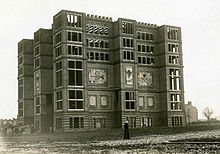
File:Jeztow2Todays Advent thought has got me thinking about nation, particularly the difference between nation and country. The thought starts with Bodenheim reflecting on the tower of Babel, which I find particularly interesting today as only a fe days ago Beth was talking about the Jezreels which is being discussed in her A level RE.

The Jezreels were a sect of the late 1800’s / early 1900’s who were just down the road from where we live. They tried to build a tower to be seen and noticed and shelter them in the end times. It’s a bit of interesting local church history.

Why build a tower? In the Babel story it was out of fear of being scattered around the world. They did not really trust God and sought their security through fame. In the local Jezreel setting I think again they did not trust God’s word, the word that says by grace we are saved …. and instead chose to build a tower out of fire retardant materials to protect them at Armageddon.

When people lose sight of the God story; that story that tells of a God who chose to become vulnerable and take on flesh by becoming the child of an unknown couple of teenagers who lived in the chav part of Israel so that we could experience God’s love for real and become fully who we are created to be, fully secure with God …. when people lose sight of that story they do alternative, and sometimes crazy, things to make them feel secure.

The difference between a nation and a country according to the dictionary is a country is defined by geography whereas a nation is defined by its political and social characteristics. A nation is defined not by geography but by belief.

We are preparing at Advent for the coming of the Christ child, for God who came so that we may exist together as one nation. So, I think Advent presents us with another choice, a twin of the choice earlier in how we use God’s word. A choice of trusting in God or trusting in our own made up systems.

Sadly it is a lot easier for us all to build our own towers of protection if we take on a seige mentality and think the world, and maybe even God, is against us. But … if God’s word is true, if grace really is enough, if God is still talking and involved today … well then maybe we can step out of those towers and work out together how we can become one nation across God’s world.

is the Bible the last word?

bible4In today’s Advent thought Bodenheim challenges us to think about the Bible, or rather how we view the Bible. She starts the thought with words from Eugene Peterson:

The simple act of buying a Bible has subtle side effects we need to counter. It is easy to suppose that since we bought it, we own it, and therefore we can use it the way we wish.’

I believe Peterson is touching on something quite serious here. How do we act if we BELIEVE that we own the bible? If we think this bible is mine? That mindset opens up the possibility of using it to back up our already held ideas. It allows us to pick and choose verses we like, while ignoring those that we do not. Many things have been justified by using the bible in this way, from slavery to domestic abuse. I think it is used in this way today in the news and in certain parts of the church with the condemnation of homosexual love and marriage. (this is another blog post for another time… but apparently the CofE is against gay marriage … I have never actually been asked … and there are very mixed views which I outlined earlier in the year here. )

On the other side of the coin, it leaves us with a choice … we can use the Bible as a weapon, to condemn, to control, to manipulate, or we can use the Bible as good news, to show how God accepts, how God loves and how God encourages us to be who he created us to be.

I believe the Bible is the word of God. If that is true, I have to ask, does the word of God condemn or liberate? Should the word of God condemn or liberate? Or does it do both or neither? Is it to be taken literally or does it need to be read in context? Is it the dictated speech of God or is it God’s word written in a particularly cultural way? Is the Bible the last of God’s words, or does God still speak today?

I wonder of we find it easy to elevate the Bible … and I fear that for some it may have become a god. Exodus 20 says; ‘I am the Lord your God, who brought you out of the land of Egypt, out of the house of slavery; you shall have no other gods before me.’ Are we in danger of idolising the word of God?

I end todays thought with Bodenheims last words for todays reading. These words challenge me to think hard. I became a Christian when I was 17, and have been brought up mainly in the evangelical wing of the church … so I particularly find these words provoke me to consider my views more deeply:

If the Bible does not point us toward God, but instead speaks for God, then the Bible has become our god.