leadership in Bruges

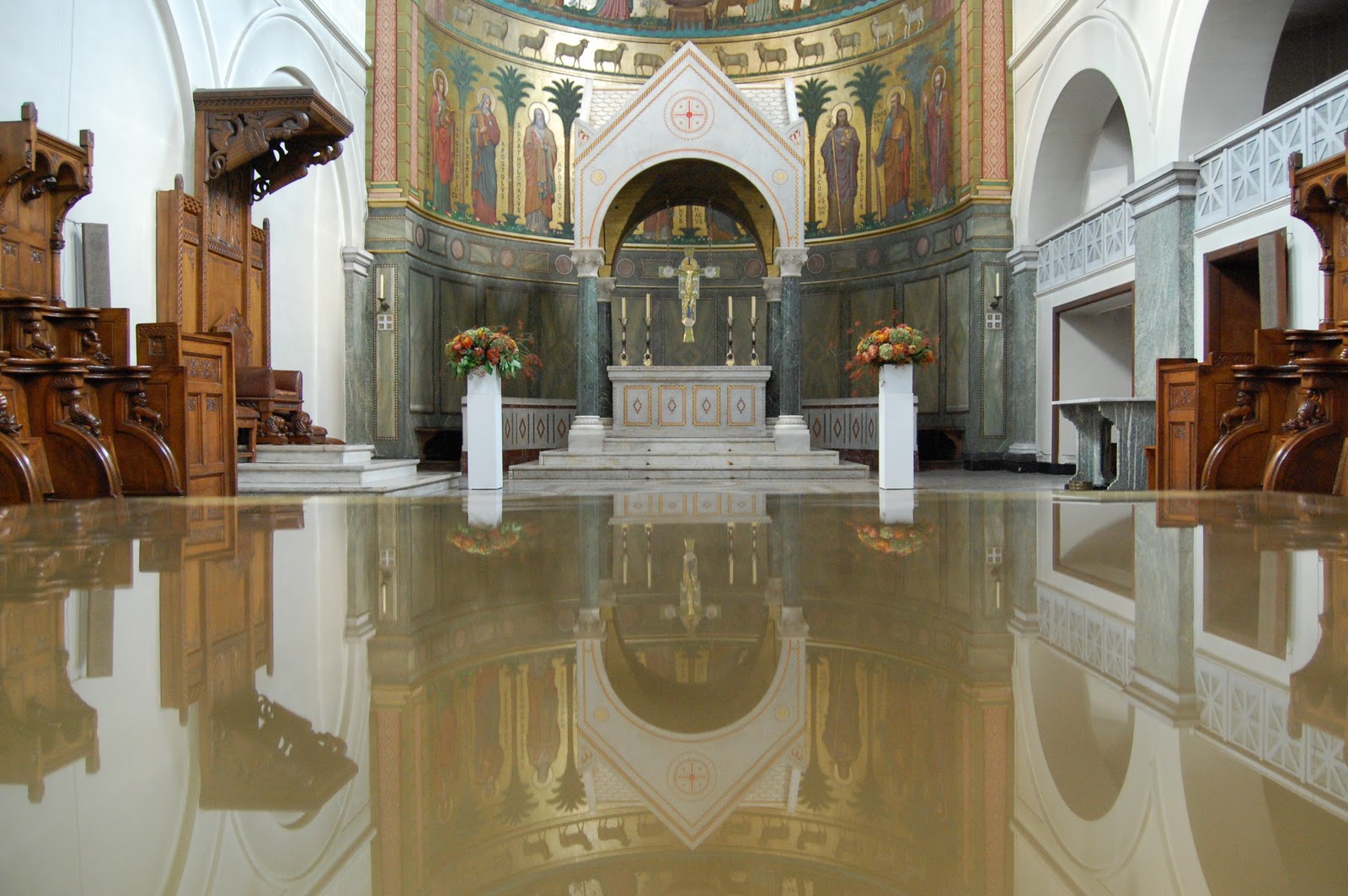
I have returned from 4 days at St Andrew’s Abbey in Bruges.

The time away was an experience and there is lots to say (and not say!) about the few days but some highs and lows:

lows:
the exclusive nature of the food which meant a couple of our group with dietary needs were excluded.
Vespers in Flemish – I’m sure the service was great but I couldn’t understand a word …
meals in silence  – personally I love silence but meals are a time for conversation, in my opinion
a packed program with little space for reflection

highs
being in a monastery in a totally different setting
I always enjoy the monastic rhythm of life which seems to energise me
space to consider things again about God and leadership
time to laugh and drink with friends and catch up with their stories

The topic of the few days was leadership and we discussed a few papers written by various theologians, although too many of them seemed to be from a Yale and Episcopal background and there are significant differences between the Episcopal model and the Anglican parish/FX model which cause me to question the validity of some of what the papers were suggesting.

On the last day we discussed a lecture given by Rowan Williams at Cuddesdon in 2004. I think this was by the best discussion we had as we considered Archbishop Rowans suggestion of priests needing to be released to be a lookout, an interpreter and a weaver. Essentially here, the Archbishop is saying that leadership is about seeing the landscape, engaging with culture, interpreting what is happening and looking for links as he shows people where Christ is working in communities today.

Any lecture that advocates any of us taking time to watch and attempt to understand before acting is worth considering in my opinion … so why not go and have a read. I think I found it encouraging too as Archbishop Rowan has given me a language to articulate what I have been attempting over the last 2 years.

It’s good to be back in Rochester. The time away was ok, I can’t say it was great as it wasn’t, but being with friends who both know when to laugh and when to be serious was a good experience – thanks guys and girls!


not ashamed … but quite confused

I’ve been asked to sign up for the Not Ashamed an initiative of Christian Concern for our Nation (CCFON).

At first sight the campaign looks good and states:
‘NOT ASHAMED’ is an opportunity for Christians across the UK to stand together and to express our confidence that Jesus Christ is good news not just for individuals or for the church but for our nation as a whole. He is the only true hope for our society.’
I can and do agree with that. That should not be a surprise to you … after all I am a priest in the Church of England. If I did not believe Jesus Christ was good news for all and the only true hope then I should be looking for another job!

But as I look at the campaign I am a little concerned. Christians are being called to show they are not ashamed by wearing some symbol on a wristband, a t-shirt, baseball cap or by wearing a badge. While that is not bad in itself, (that common outlook can encourage people) I am concerned at the lack of practical good news action that is suggested here. Christians are being called upon to ‘explain to friends, neighbours, colleagues, family and others why Jesus Christ is such good news for individuals and for our society.’ But Surely it would be far more fitting with gospel values if we spoke and explained less and acted practically a lot more by actually being good news rather than just talking about it. Explaining why Jesus is good news is one thing, but if we can’t back that explanation with practical action that makes a difference then I would argue that those words do not really have any value.

Sadly as I look further intio the campaign I am saddened by the second claim which I can’t agree with (and so ultimately cannot sign up to this campaign … and I guess that means some will think I am ashamed of my faith, but nothing could be further from the truth!)

The second claim, or more accurately a demand, cannot actually be found on the website. To find this you have to download the pdf leaflet which adds:
WE CALL on government, employers and other leaders in our country to protect the freedom of Christians to participate in public life without compromising biblical teaching and to promote in our society the values that are revealed through Jesus Christ and that have so shaped our nation, for the good of all.’    
I don’t understand the reasoning for this call. As I have said before here on SHP I do not believe Christianity is marginalised in our nation. I’m actually quite sickened by the claim and thought. I don’t understand what Biblical teaching is being undermined, apart from our clear commands to help the poor and marginalised, but I suspect that is not the Biblical teaching this campaign is talking about. Sadly my fear is that people will see this as a demand from all the church serving our own interests when in fact it is only from a particular section of the church.
Most of all, I want to know where this teaching and idea comes from.
Where in the gospels does Jesus say campaign for your own rights?
Where in the bible does it say we should campaign to make things better for ourselves?
Is this campaign going to speak out for the poor, the marginalised and those who will be suffering more after benefits cuts as time progresses …. or is it only going to speak out for those that can’t wear their chosen jewellery even though their employers have always had a no jewellery rule?
I’m very open to being shown I am wrong … at the moment I am just very concerned and confused!

sacred stuff

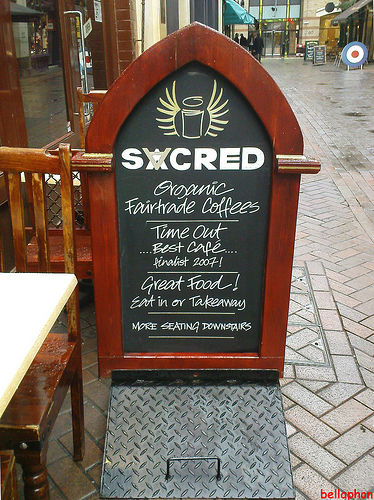
I met up yesterday with Richard in London at Sacred Cafe, a place I used to joke about when I worked in YFC of being one of my London offices. It was great to have the opportunity to meet up with Richard and hear what is happening in YFC and share what was happening with ourselves and families – just a great catch up session with a good friend … oh yes and VERY good coffee!

I really miss the ‘vibe’ of London and one part of my old job that I really miss is connecting with lots of other people on the same wavelength and chatting over mission and other stuff!

On my journey home I found myself reflecting on the hundreds of conversations that I have had with other great people in Sacred Cafe.  I thought back to very special ‘epiphany’ meetings, meetings of tears and meetings of great laughter and joy. Because of that, for me, it’s not just the coffee in this special place that is sacred! Sacred Cafe is one of those special places where I have both connected with God and seen God work in some amazing ways …. maybe even more of a church than some churches I have experienced over the years!

why?

It’s been a bit if a busy Sunday with 8am BCP and a talk from the BCP lectionary and preaching at the Eucharist, with a talk from the Common Worship lectionary. Why can’t these two lectionaries tie up??

So this morning at 8 I preached on the greatest commandment and at the eucharist I preached on Psalm 137 which has an ‘interesting’ ending to preach on. Although I went down the ‘memory’ route of this psalm, believing it to be about remembering our heritage and we are called to as Christians, I felt quite strongly that too often we avoid the difficult and tricky parts of the bible and so we looked at what this end verse might be about.

In all honesty …. I’m not sure! I mean why is such a Tarantino horrific verse in the Bible – and why in a song to God!? I wondered whether the venting of such angry stuff to God was therapeutic in some way, but I’m still unsure why this is in a psalm of worship? I guess there is an argument saying that shouting out our anger to God may act as a vent and that will be it, but I’m not sure. I guess today I am confused curate wondering why this is there!

Today, though, is a strong example of why a different method of teaching other than sermon would have been great. To discuss this in different groups and learn from each other would have been a much more interesting and valuable use of time. I have thought for a while that the sermon has had its day …. not there’s another post to rile people!!

the temporary …

I have been catching up on some podcast listening which is made easier now that I have started to return to the gym as I like to challenge my thinking as I challenge my body physically.  I particularly like listening to Rob Bell sermons from Mars Hill Michigan. Two other podcasts I listen to regularly are the Moot podcast and, more recently I have discovered, the Nomad podcast.

It just so happens that both the moot and the nomad podcasts have an interview with Kester Brewin. Complex Christ, one of Kester’s book, was pretty formational for me and so I was intrigued to hear what he was speaking on in these podcasts and I was not surprised to hear him covering a lot – both are worth listening to, and you don’t need to go to the gym to do that!

One of the things that Kester speaks on is ‘the temporary’ which is worth giving some thought to. I think Kester was saying that church and communities like that only ever are temporary as they serve a purpose. If they become permanent then they risk become idolatrous such that people end up serving the church rather than the church serving the people. When organisations become idolatrous in this way then often we see violence occur as people as people feel the need to protect their structures.

This, claims Kester, is one of the things that Jesus demolished when he came through his words in Mark 2:27. WE need structures, says Kester, that we inhabit rather than structures that control us and therefore we need to regularly look at them to ensure that the structure/organisation/church is being helpful. When it no longer is then it needs to be brought to an end or changed.

I think I partly agree and I think I partly disagree. Part of me wants to stand up and shout ‘yes’ because it actually makes a lot of sense. The other part of me is concerned, however, for the many people who need some stability and who would be quite unsettled to think that everything around them is temporary. But then, one of the things that so frustrates me about established church is the ‘we’ve always done it like this’ attitude which destroys any attempt to engage with real life.

I guess, on balance, if we have an attitude of temporariness acknowledging that we need to keep asking the question ‘is this helping’ and being ready to chance to enable us to hold on to the permanence of our need to engage with God, people and culture relevantly then that coud work. Or is that just a little too confusing?

I dance for Jesus

A while ago I wrote about the condemnation of others for not fitting with our reading of certain doctrines or for not fitting with our assumed lifestyles. Certainly the gathering, the developing christian community that I am part of, strongly believes how we live our faith is far more important than what we believe. You can fairly easily believe ‘God is love’ and ‘Jesus is the only way’ but if you treat people that disagree with you with contempt and ridicule or refuse to even talk to them, then I would say something of the gospel ‘good news of acceptance and love’ has been lost.

A few months ago I found myself in a coffee shop talking to a young woman who was passing through Rochester. This woman is a Christian although she has not been able to settle in an established church set up. This has a lot to do with the fact that this Christian woman also happens to be a lap dancer. Churches that she has tried to join have condemned her because of her job and way of life. When she first became a Christian she gave up her job, because others in the church told her it was wrong, and tried to get other jobs. People told her that God would provide other things to make money for her and her young daughter, but as she tried living in the way others suggested, church after church offered little support and eventually other work was provided …. in another lap dancing club.

The way she spoke of God showed me that without a doubt this woman has a thriving relationship with the living God. She was clearly in love with the God who created her and spoke of Jesus in a way that I have not heard anyone talk in a long while. I felt that her trust in Jesus was incredibly strong. This young woman understood God’s grace, she understood she was loved and she longed for a christian community to accept her fully. I don’t know where she is today but I fear she is alone and living her Christian life outside of Christian community.

I was reminded of this woman during the summer when I read a report in the Independent newspaper on lap dancing outlining research that showed 40% of lap dancers in the UK have a uni degree or are studying for one. I personally thought the article was glamourising or missing the real issue and  I must admit I am of a similar mind to Amy Jenkins who responds in the opinion section of the newspaper that irrespective of education lap dancing is degrading. I believe that to be the case but ….

Something about this woman struck me. This was not her job of choice but I sensed that she felt this was where God wanted her. I plucked up the courage to ask the burning question …’ok, you are a lap dancer and a Christian …. how do you reconcile the two?’ Her answer still brings tears to my eyes:

‘all the girls think of something when they dance. I pray on stage and I dance for Jesus. This is my worship, he created my body … I use my body to worship him.’

Some will have issues with that, some will say it is not morally possible, and a large part of me might go along with that, but what is a Christian other than someone who totally loves God and wants their life to be worship of Christ? Whatever way I recall this encounter in the coffee shop I remember the girls faith and commitment as she said ‘I dance for Jesus’.

Sometimes I just don’t know what to think ….

Mary Magdalene’s example

Each day for me starts with Common Worship Morning Prayer. It’s a lot of words for 8am but I am amazed as I look back and discover how these words, and the practice of gathering for prayer, has sustained be over the last two years. Today, in our prayer, we remembered Mary Magdalene. Tradition tells us that Mary Magdalene was one of the most important women who traveled with Jesus. She was the leader of a group of women disciples who followed Jesus, and interestingly is one that stays around at the foot of the cross when all the male disciples disappear in fear! She was also thought of as being special by Jesus as he chose to appear to her before anyone else after his resurrection.  


In our New Testament reading this morning we read these words from LUke chapter 8:


Soon afterwards he went on through cities and villages, proclaiming and bringing the good news of the kingdom of God.


The two highlighted  words caught my attention. Jesus proclaimed and brought the good news. They are two distinct actions. I hear a lot about proclaiming the good news but hear very little about bringing good news. I wonder if that is because talking about something is always very much easier than being and doing the very thing being spoken of?


In the example of Mary Magdalene today I wonder whether we have an example of a person who was able to live out the reality of proclaiming and bringing good news. Her life backed up her words. When things got tough she did not disappear. At Jesus’ time of need on the cross was Mary Magdalene good news to him? Surely, a friendly face, even a friendly face in pain and anguish at what she was seeing was a welcome sight after everyone else had deserted him?


It seems that Mary, more so than the other disciples, had a greater understanding of what it meant to follow Jesus; that being good news is something about ‘being there’ even when it hurts and you put yourself at risk. 


I have found the character of Mary Magdalene a challenge to me today.

my first wedding

I experienced another first at the weekend in ‘doing’ my first wedding. Until this particular day the most nervous I had been was just before signing the opening 3 lines of the eucharistic prayer in the cathedral. That still gets to me (I was in the office this morning practicing 45 mins. before the service started!) but I was very surprised how nervous I was before the wedding ceremony yesterday.

I guess I was very conscious of how things could go ‘wrong’ with signing licences and the other legal stuff. More importantly this is a very special, and unrepeatable day, for this couple. I really wanted to ensure I had prepared fully so that they could enjoy their day as much as possible.

Everything seemed to go well and I was struck, again, how fortunate I am as I get to share some very special moments with people. To be able to serve people in this way is pretty amazing and I am remembering again how privileged I am in being where I am doing what I am doing.

I get to officiate at another wedding next week so that’s pretty cool!

unique images of God

I have had loads of conversations with different people in different settings with people recently and, amazingly, these conversations could be summed up in the question of: ‘what is christianity all about?’ The conversations have mainly been with those that have rejected Christianity, and maybe all institutional religions, but I have also found myself talking about this with a few Christians.

These conversations have quickly turned to asking the question of whether Christianity is about a set of rules to follow or more about a lifestyle or a journey. One such conversation was started by someone holding a postcard from the gathering. The person was intrigued that we should use a labyrinth as a symbol. As we chatted she shared her belief that Christianity was so obviously about a set of rues that had to be strictly followed. She shared that churches she had attended were all very clear on this. When I asked what she meant she replied something like ‘well to fit in you needed to agree with everyone else.’

I shared that as the gathering we use the labyrinth on our card as we believe that Christianity is more about a journey and lifestyle than it is about set rules or doctrine. Although we travel the journey together we believe it is wrong to think we should all travel at the same pace or be in the same places or necessarily believe the same bits of doctrine as Christian faith is wider than any ‘tradition’ of church – there is freedom, too, to just dwell at certain places on the journey for as long as people want to. Jesus came to fulfil the law which means it is now something we respect but no longer governs what we do(a bit like a guardian/teacher figure – I preached on this a little more here last week in the cathedral). The focus now is on a relationship with God rather than a set of rules.

We also chatted about my belief that Christianity is about love and compassion rather than doctrine and that Christian communities, like the gathering and church, should be the ones that actually change as people join them, rather than the community expecting or giving the impression that people need to change before they can fully join. If we are all created in the image of God, then the very fact that we are unique human beings means that we all carry something unique of God within ourselves. If we expect people to leave their uniqueness at the door of our gatherings then we are merely depriving (1) ourselves of understanding more of the God that we say we are trying to discover and (2) others of helping us to understand more of the God we wish to follow.

This conversation with this woman was not a one off. Over the last few months, in various guises, it has been replicated time and time again in conversations with male and female, young and old. When the language turns to christian spirituality, acceptance, compassion and journey a spark of interest appears, but it soon extinguishes. Somehow the church, christians such as myself, have portrayed christian faith not as freedom to love and live as it is, but as a set of rules, of strict doctrine, that controls and directs. People have the idea that the church simply wants conformity as conformity is easy to control.

I’m not sure what we can do about this though … as there does seems to be some truth in this observation.

New Bishop of Rochester

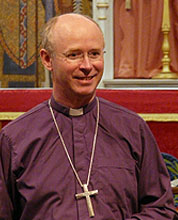
It has just been announced that the next Bishop of Rochester will be The Rt Revd James Langstaff, currently Suffragen Bishop of Lynn in Norwich Diocese.

The press release from the diocese can be seen here.

He is going to be traveling around the diocese today so you may bump into him! It’s really exciting top know who the next person will be at last.