vulnerability growing hospitality

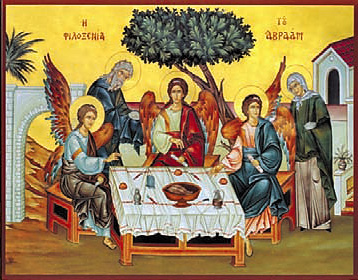
Hospitality_of_AbrahamGraham wrote an interesting post today that has caused me to think more about the whole vulnerability thing. In the post (go read first) called ‘welcome’ Graham outlines a typical scene that is no doubt common in many churches which causes him to ask ‘why’?

‘Why didn’t any of the hosts get up and make themselves vulnerable for the guests?’
“why didn’t I make myself vulnerable so that the guests were made to feel in the place of honour?’

I’m intrigued by the link that Graham is making between hospitality and the vulnerability of the host. Many new monastic communities, for example, speak of a radical hospitality. In the gathering we have used that very phrase … to show a radical hospitality towards those we come across. Its seems to me that after reading Graham’s words this type of hospitality may only be offered when we are willing to allow ourselves that vulnerability that allows the guest to be themselves and be accepted as themselves.

It’s easy to show hospitality to friends and people we know … basically those that we believe may well reciprocate the hospitality in some way. I would question whether that is really hospitality. But hospitality to the stranger who desperately needs help and who may stay a while and who we may never see again after they leave … that is a real genuine radical type of hospitality.

A hospitality where the host is willing to give up everything, to be totally vulnerable, so that the guest may feel welcome, accepted and feel ‘at home’ is a hospitality that calls to me in some whispering challenge. As I look over that last sentence I think of Eucharist … the host in complete vulnerability, arms wide in both submission and welcome … allowing all who need to, to be able to come, feed, be themselves, be at home and move on when ready.

Maybe there is something there of what Nouwen meant when he wrote:

“Hospitality means primarily the creation of free space where the stranger can enter and become a friend instead of an enemy. Hospitality is not to change people, but to offer them space where change can take place. It is not to bring men and women over to our side, but to offer freedom not disturbed by dividing lines.” 
– Henri Nouwen, Reaching Out: The Three Movements of the Spiritual Life

I’m going to think more on this hospitality and vulnerability thing … there is more to think about … thanks Graham … and please, anyone, feel free to add your thoughts …


real protection

data_protection_singapore1I have really found the Richard Rohr thought series very powerful and awakening this week. The series has been looking at the ‘loyal soldier’ within us, the person who is a bit like the older brother in the story of the prodigal son. The part part of our character that is bound by rules, that tells us how we should be and act and what we should believe … the part of our character that chooses to avoid taking on board that Christianity is a mystical matter because then it allows it to restrict it more comfortably to a moral, right and wrong, matter. That’s a lot easier to deal with and allows us to control who is in or out and gives us control over stuff we don’t really know how to control. But … while it’s ‘easy’ to try and live through rules that ‘protect’ us … faith with Christ means we do this by letting go and allowing him the space …

Today’s thought starts …

Early-stage morality seems to be determined by what some call the world of karma or some kind of equalization between debt and punishment, merit and reward. It seeks to create some “justice” between output and input, so the world can make sense to our small self. The Loyal Soldier voices that developed in our early childhood said, “You get what you deserve. You don’t deserve anything more than what you’ve earned and are therefore worthy of receiving.” This simple worldview likes “bad” people to be punished and “good” people to be rewarded.

go read it all here.


if it doesn’t look like Jesus, it’s not God!

imagesThis may come as a little shock … but I have avoided a lot of the mainstream evangelical mass produced Christian stuff over the last couple of years. I have done so because a lot of it simply leaves me feeling sad. What I interpret, read and hear as a lot of legalism of how one should act, dress, believe and behave worries me as I try to follow a God who is full of love, grace and acceptance.

Rather than being sad I smiled with delight when I came across this article in Christianity magazine by Steve Chalke. Some people will read no further because I am linking to Steve … it astounds me that a large part of the evangelical church here can, one minute hold someone like Steve up with pride and then, when he starts to challenge their thinking, dismiss him and refuse to take him seriously, even accusing him of being a heretic.

I loved reading Steve’s article as he simply asks us, ‘have we misread the bible?’ For a long time many have been saying so … but Steve is one of the first to stand up from within evangelicalism and challenge some strongly held, and in my opinion wrongly held, evangelical views. Steve challenges us to take the whole Bible seriously, and not just keep pulling out parts that support the argument we wish to represent.  ‘If we fail to take the whole bible seriously including those bits we find unpalatable or inconvenient’, says Steve, ‘we only pay lip service to its authority’. Despite what some might say, Steve is not watering down the Bible, but the exact opposite – he wants it taken in complete seriousness!

One important aid to interpretation that I loved comes from a simple saying, ‘if it doesn’t look like Jesus, it’s not God’. Jesus is both our guide to biblical interpretation and to life.

Last week I came into a conversation with a Christian man arguing with a young woman. He was quite foul in his attitude and language on top of extreme sexism and unpleasant racism thrown in as well. He backed his views up entirely with scripture … but my problem was … it didn’t look one iota like Jesus. The man expressed an ugly unattractive legalistic view of faith. It did not look like Jesus, so how can it of been God?

As Steve draws out the bible does not give us answers to a number of spiritual and moral issues. our task, as Christian community then, is to wrestle with the meaning of these words both honestly and humbly.

On a different, but very related note, I loved this article on Rachel’s blog. The way the bible has been misinterpreted to control and abuse woman has been something that angers rather than saddens me. Rachel’s article is cleverly written, light and humorous … but with a seriously deep challenge.

You see… this whole thing of taking stuff out of context and forgetting what Jesus is like means we become distorted to the point of ugliness in how we act as Christians. If we don’t look like the Jesus of the gospels then there is something seriously wrong … and when Christians stand outside clinics or airports with foul signs of hate and intimidation …. then something is very seriously wrong.

So … go read the articles – Steve’s here and Rachel’s here.

Then …. come back … and talk … there will be some of you that disagree!

murder and the value of truth

friday-night-theology-largeEach week I receive the ‘Friday Night Theology‘ from the EA.

Often it makes me think, sometimes it has added to my sermon when preaching. The short article is always contemporary, in an attempt to respond meaningfully to the headlines we read. You can subscribe to Friday Night Theology here.

Today I wish to to quote it here in its entirety. If we had pub theology this month (we never do in August!), I’m sure we would pull something from this topic

Today Jonty Langley (Baptist Times) writes under the title ‘Murder and the Value of Truth’:

I just watched 12 people get murdered on YouTube. I’ve watched them die before, but today I watched it happen again. It felt important. It felt like the least I could do. Because I’ve watched the video, a brave man is likely to go to jail. The murderers will not.

I hope it’s obvious to you that the video I’m talking about was leaked by an American soldier called Bradley Manning. It shows a group of unarmed men being killed by American forces in Iraq. Let’s remember what happens. As I say, it is the least we can do.

The men are unarmed, standing on a corner. The viewer watches from the point of view of an attack helicopter as it fires its unimaginably powerful machine guns at the men, who try to run or take shelter, but there is really nowhere they can hide from bullets of this size and velocity. Those who aren’t killed immediately, who cower behind a wall, are fired on again. As the smoke clears a man (a journalist, it turns out) is moving. He’s crawling onto a pavement. The recorded voices of the American helicopter crew dare him to pick up a weapon.

A moment later, a van drives along the street and, as any human being would expect, it stops. People get out. They start carrying bodies, dead or wounded, to the van, and they too are fired on. The force of the bullets spins the vehicle around, explodes the street in clouds of dust and kills almost everyone. At least one child is left alive but badly wounded. A foot-soldier who arrives on the scene asks for one of the helicopters to airlift her to hospital. His request is denied. “It’s their fault,” says one of the voices on the military radio. “For bringing their kids into a battle.”

This week, Bradley Manning was found guilty of five counts of espionage in a military court because he leaked that video and a number of other classified documents. I think he’s a hero. I can’t understand why the Church, which calls itself pro-life, which preaches bringing into the light the things done in darkness, which tells its children that the Ten Commandments, are the cornerstone of good living, is not shouting from the rooftops that he is, too.

The people who killed 12 unarmed men, who grumbled “Come on, let us shoot!” and who laughed as a tank drove over one of the bodies, are free. They are our allies. This is our war, being prosecuted in our name. And I am not going to lecture you about the prophetic tradition of justice in the Bible. And I’m not going to tell you what to believe about Thou Shalt Not Kill in the context of war. I will tell you that the people involved in this killing are not heroes, they are murderers. And blaming them is pointless.

Trained, indoctrinated and ordered to murder, who of us would have the courage or the freedom of mind not to? The soldiers who did this, the people who trained them, the men and women who gave them their orders are a symptom of a larger problem. The empire at the centre of our world is sick. It is misguided. It has categorised people into those who deserve protection by virtue of their nationality or the things that they believe, and those who do not matter.

And perhaps, as Christians, we must simply render unto Caesar what the empire demands. Perhaps fighting back on the same terms as the rulers of this dark world just makes us like them. But, if that is true, the least we can do is reveal the truth. The least we can do is encourage the likes of Bradley Manning. The least we can do, in the face of evil we cannot on our own defeat, is shine a light in its face.

Jonty Langley is a writer and works for a Christian mission agency.

I think it’s a thought provoking read. I’d be interested too in whether there is a difference in perception and reaction here between my British and American friends?

walk … don’t run

overcastabI have just returned from an amazingly relaxing time in Cornwall with some good friends. I had some plans for things to do, but actually when I got there found myself to be pretty exhausted and simply happy to be in a good place with good friends.

I spent a lot of time looking out of the window … the view in the photo shows why. I still find I can endlessly watch the sea and become immersed in its movement, as I regularly did as I was growing up in Weymouth. I find even now that I can easily lose myself to the extent of not hearing others when we they talk to me, something that Sarah often teases me over! Clearly, for me, proximity to the sea is something like a thin place.

This time while in Cornwall I was reminded of these words from Rob Bell: (thanks Graham)

Walk, don’t run.
That’s it.

Walk, don’t run. Slow down, breathe
deeply, and open your eyes because there’s

a whole world right here within this one. The
bush doesn’t suddenly catch on fire, it’s been
burning the whole time. Moses is simply moving
slowly enough to see it. And when he
does, he takes off his sandals. Not because
the ground has suddenly become holy, but
because he’s just now becoming aware that
the ground has been holy the whole time.

Efficiency is not God’s highest goal for your life,
neither is busyness,
or how many things you can get done in one day,
or speed,
or even success.
 
But walking-
which leads to seeing-
now that’s something.
 
That’s the invitation for every one of us today
and every day, in every conversation, interaction,
event, and moment: to walk, not run. And in doing
so, to see a whole world right here within this one.
Walking and seeing a whole world, slowing down enough so that I can see that the ground urlI walk on is holy is amazingly easy to do in a place like Cornwall, with friends, while resting and gazing at amazing scenery and beautiful sunsets.
But back in Gillingham it is harder.
The ground here is no less holy than that bathed in the glorious colour of a sunset. It’s no less Godly because it’s harshness is sometimes painful to the eye. Maybe we, I, simply don’t always acknowledge the holiness of the paving slabs because I don’t slow down enough to see. It may not be a thin place, but it is a holy place, holy ground.
I guess my prayer needs to be something like …. ‘Lord, teach me to walk, so that I may see.’

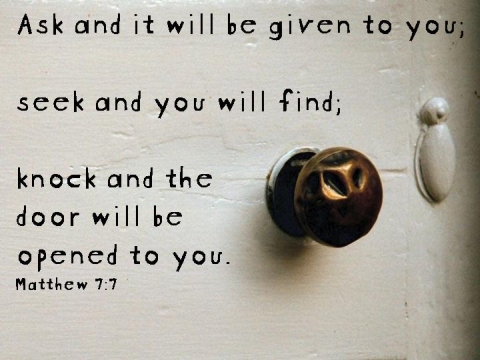
are we ready to … Ask Seek Knock

ask-seek-and-knockAsk …. seek …. knock.
Ask and it will be given to you.
Seek and you will find.
Knock and the door will be opened.

These words of Christ that have been both a comfort and a challenge to me over the years. It would seem that now, though, they are becoming increasingly more of a challenge than a comfort. It is easy to run these words off to ourselves and others as an indication of a warm comfortable promise but, on both a personal and ministry level, I am finding the warm comfort has shifted to allow more of the hot prodding poker of a challenge.

As I think around, and reflect upon, these words of Christ I am discovering that these words of Christ demand a certain level of authenticity from me. They demand an authenticity in understanding that there is no point in asking if you think you already know the answer. An authenticity that refuses to seek or search for something  if you are not prepared to accept, and act upon, what you find. An authenticity that will not knock on the door until you are willing to step inside, and stay awhile, should you be invited.

I have come across quite a few people, over the last few months, who are struggling with faith, truth and life. They are experiencing stuff that is not compatible with their current belief system or developed faith. I wonder, though, whether they are actually struggling with faith as such, or whether they are struggling more with their discoveries from their asking, their seeking and their knocking.

You see, this lifestyle of question (ask), explore (seek) and introduction (knock) can cause us problems. Only the other day a Christian friend asked me about some issue that they feel they cannot raise in their church because the very raising, or asking, would bring a negative reaction. I believe this is why pub theology, a safe and accepting place to question and explore, has worked so well.

If what we believe is the truth then it will, stand up to re-analysis in light of experience. I don’t think with the the ask, seek, knock thing that was Jesus suggesting that this was supposed to be a one off event, but more of a lifestyle choice? I can’t be sure, and maybe others can argue for the one off event thing … but I’m going to go with the lifestyle choice one …

To do that we must be prepared to change depending on what we may find as we question, explore and introduce ourselves. God is not in a tidy little box and neither can the love and pain of Gods creation be squeezed. Every time we encounter God we are changed … it’s inevitable …. God IS never-changing …. but as we ask seek knock maybe our understanding changes

So … Ask … seek … knock …. and see what happens!

experiencing the holy

Todays daily meditation from Richard Rohr…On these “thin days,” as the ancient Celts called them, All Saints Day and All Souls Day (Nov. 2), we are invited to be aware of deep time when past, present, and future time all come together as one. On these pivotal days we are reminded that our ancestors are still in us and work with us and through us. Protestants thought it was about “worshiping” saints, but that largely missed the point.

Actually this is a Christian meaning for reincarnation, which Christians also called “the communion of saints” in the Apostle’s Creed. This was the common and corporate notion of the human person. It realized that our ancestors are indeed in us and with us (as modern DNA studies can now prove), and then early Christianity added maybe even for us! We were quite foolish to make fun of many Native and Eastern religions, which we dismissed as “mere ancestor worship” who usually had the more corporate notion of personhood, far removed from the myth of modern individualism. All Saints Day is a celebration of all of us precisely in our togetherness, which is why the New Testament (in twenty places!) called all God lovers “the saints.”

Discuss ….

claiming protection vs embracing vulnerability

Recently I had a kind of discussion with someone who is passionate about mission whom I admire and respect. In her encouragement of me she said something like ‘get your armour on!’

I thought ‘yes, you are so wise for someone so young, why had I not thought of that!’ But then, after a little while I wondered … and I blog about this because I still wonder and I am not sure. You see, I know I need God’s protection and I know that we are often engaged in a  spiritual battle which we do not fully understand nor are we fully aware of.

But … should I be prayerfully putting armour on as outlined in Ephesians 6? I see this is scripturally correct behaviour …. but is this an instruction for all seasons? I guess my concern is with imagery and the power of imagery. Does a ritual of putting on the ‘armour of God’ cause the mind to take on a seige/battle/confrontational attitude? I fear that it might.

My problem is I am not sure I am called to fight in the role I have at this time. I am not sure that this outlook is helpful in what I do at this stage of doing it. I do know that I am called to be present, to be open. to listen, to get to know people and … all this means (gulp!) that I am called to be vulnerable.

I am not sure how vulnerable I am if I am wearing a suite of armour, even a symbolic one. I wonder if as well as having seasons for wearing armour there are seasons for being vulnerable and simply trusting God alone.

The image I have to illustrate my thoughts are of Arthur and Merlin in the BBC series currently showing here in the UK. King Arthur relies on his armour and battle skills. Merlin, by contrast, wears no armour and carries no weapons, trusting merely in the skills and gifts that his creator has gifted to him.  It’s no surprise that it is Merlin and his wise use of his gifts that often win the day. It’s not a great illustration but it resonates and has tastes of the un-armoured boy David against the heavily armoured Goliath and Jesus who not only has the gifts from the creator but chooses not to use them and allow his sacrifice to happen.

So … claiming protection or embracing vulnerability, what should I do ….. or is there a bit of both needed here?

What do others think? What do other pioneers do as they prepare to ‘go out’ and pioneer. How do you prepare?

At this point in time … my prayer of preparation is borrowed from the Northumberland Community: (which I guess could be viewed as a kind of compromise).

Christ, as a light
illumine and guide me.
Christ, as a shield
overshadow me.
Christ under me;
Christ over me,
Christ beside me
on my left and my right.

This day be within and without me,
lowly and meek, yet all-powerful.
Be in the heart of each to whom I speak;
in the mouth of each who speaks unto me.
This day be within and without me,
lowly and meek, yet all-powerful.
Christ as a light;
Christ as a shield;
Christ beside me
on my left and my right.

from Coffee to Perichoresis

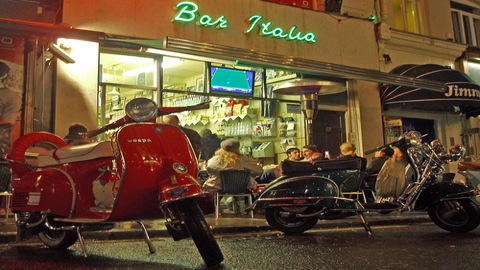
It was great to get back into London yesterday … met up with Richard in Bar Italia (amazingly good coffee and vibe and well worth a visit!) and had a little wander around before making my way over to Ian’s book launch.

I enjoyed the evening on a number of fronts. It was good to meet up with Moot friends that I have not seen for far too long! It was good, as always, to hear from Ian who spoke well and both challenged and encouraged. It was good to meet up with others who are simply trying and asking similar questions about church, life and the universe!

Ian spoke about the Trinity, perichoresis and dancing with God. He shared his view on how Christians in the west have lost sight of relationship with a Trintarian, communal God. I agree with much of what Ian said …. if we can experience more of the Trinity, which by the very nature is community, then this can only aid us better as we attempt, as church, to reach out to and engage with a very individualistic society that simply craves the experience of community, but has no idea to achieve it. If God is community, and we engage in that community, people find God meeting their need.

Experiencing, rather than just learning about, the Trinitarian God … Trinitarian theologyis, says Ian, key to recovering a depth of relationship (in church and society) that has been missing for so long.

Anyway … God Unknown, by Ian Mobsby … go buy!

Returning to first principles

I am really looking forward to being at the launch of Ian Mobsby’s new book on Thursday evening at the London Centre of Spirituality  – it looks like it will be a great couple of hours so why not come along too?

I am in the incredibly lucky situation to have Ian as a mentor. Since being placed with Ian many years ago at Moot while training on SEITE I have been meeting with Ian regularly to chat about what I do. Ian has been a great support and a great challenger … as every good mentor should be.

What I have really appreciated about our relationship, apart from Ian’s friendship and honesty, has been the way Ian has explored this whole role of the Trinity in mission. Sometimes he has blown my mind, or confused me, or challenged me. It has all been good stuff as part of the write up says here:

‘In this presentation, Ian Mobsby explores a central theme of his new book ‘God Unknown: The Trinity in contemporary Spirituality and Mission’.  The Holy Trinity is the central reality and concept that makes Christianity a distinct faith and not a jewish cult. As such God is a missionary God that challenges the Church and all Christians to participate in this mission and ministry of reconciliation, as God seeks to restore all things into renewed relationship with the divine.  In our increasingly post-secular context where people are more interested in spirituality than religion, it is the reality of the Trinity that gives us hope and opens up the spiritual landscape of the faith to those who are un-or-dechurched’. 

So … as I said above … come along …. you won’t regret it!