protect it .. or live by it?

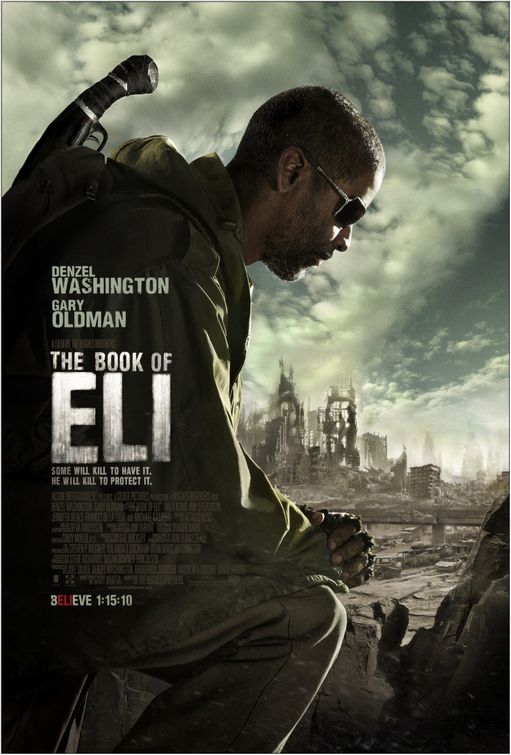
I finally got around to watching The Book of Eli the other day. It’s another apocalyptic film, a film that depicts the regression of humanity when the bubble of technology bursts.

Without spoling the film too much, Eli (played by Denzel Washington) is carrying the worlds last copy of the Bible which another character, Carnegie (Gary Oldman) is fairly desperate to get his hands on by any means. Some of the scenes are fairly brutal as he attempts to find ‘the book’.

There comes a time in the film when Eli seems to give the book away, and his new found friend, Solara (Mila Kunis) expresses her surprise , saying that she did not think anything would be able to make him give up the book. I think Eli’s response could be a challenge to the church of today:

‘In all these years I’ve been carrying it and reading it every day, I got so caught up in keeping it safe  that I forgot to live by what I learned from it’

Do we, as church, get so embroiled in protecting scripture that we forget to live by its teachings. Have some people become more passionate for protecting the word than they have for the message? I would suggest that some parts of the church have fallen into this and in doing so have lost the central message of the book they protect.

Without wanting to be repetitive …. that would be ‘love’.

why?

It’s been a bit if a busy Sunday with 8am BCP and a talk from the BCP lectionary and preaching at the Eucharist, with a talk from the Common Worship lectionary. Why can’t these two lectionaries tie up??

So this morning at 8 I preached on the greatest commandment and at the eucharist I preached on Psalm 137 which has an ‘interesting’ ending to preach on. Although I went down the ‘memory’ route of this psalm, believing it to be about remembering our heritage and we are called to as Christians, I felt quite strongly that too often we avoid the difficult and tricky parts of the bible and so we looked at what this end verse might be about.

In all honesty …. I’m not sure! I mean why is such a Tarantino horrific verse in the Bible – and why in a song to God!? I wondered whether the venting of such angry stuff to God was therapeutic in some way, but I’m still unsure why this is in a psalm of worship? I guess there is an argument saying that shouting out our anger to God may act as a vent and that will be it, but I’m not sure. I guess today I am confused curate wondering why this is there!

Today, though, is a strong example of why a different method of teaching other than sermon would have been great. To discuss this in different groups and learn from each other would have been a much more interesting and valuable use of time. I have thought for a while that the sermon has had its day …. not there’s another post to rile people!!

the Father’s letter

I caught this over on Rachel’s blog and I simply loved it. Not sure where t comes from, but it’s a great collection of scripture.

My Child..

You may not know me, but I know everything about you.Psalm 139:1

I know when you sit down and when you rise up.Psalm 139:2

I am familiar with all your ways .Psalm 139:3

Even the very hairs on your head are numbered.Matthew 10:29-31

For you were made in my image.Genesis 1:27

In me you live and move and have your being.Acts 17:28

For you are my offspring.Acts 17:28

I knew you even before you were conceived.Jeremiah 1:4-5

I chose you when I planned creation.Ephesians 1:11-12

You were not a mistake.Psalm 139:15-16

For all your days are written in my book.Psalm 139:15-16

I determined the exact time of your birth and where you would live.Acts 17:26

You are fearfully and wonderfully made.Psalm 139:14

I knit you together in your mother’s womb.Psalm 139:13

And brought you forth on the day you were born.Psalm 71:6

I have been misrepresented by those who don’t know me.John 8:41-44

I am not distant and angry, but am the complete expression of love .1 John 4:16

And it is my desire to lavish my love on you..1 John 3:1

Simply because you are my child and I am your Father.1 John 3:1

I offer you more than your earthly father ever could.Matthew 7:11

For I am the perfect Father.Matthew 5:48

Every good gift that you receive comes from my hand.James 1:17

For I am your provider and I meet all your needs.Matthew 6:31-33

My plan for your future has always been filled with hope.Jeremiah 29:11

Because I love you with an everlasting love.Jeremiah 31:3

My thoughts toward you are countless as the sand on the seashore.Psalm 139:17-18

And I rejoice over you with singing.Zephaniah 3:17

I will never stop doing good to you .Jeremiah 32:40

For you are my treasured possession . Exodus 19:5

I desire to establish you with all my heart and all my soul.Jeremiah 32:41

And I want to show you great and marvelous things.Jeremiah 33:3

If you seek me with all your heart, you will find me.Deuteronomy 4:29

Delight in me and I will give you the desires of your heart . Psalm 37:4

For it is I who gave you those desires. Philippians 2:13

I am able to do more for you than you could possibly imagine.Ephesians 3:20

For I am your greatest encourager.2 Thessalonians 2:16-17

I am also the Father who comforts you in all your troubles .2 Corinthians 1:3-4

When you are brokenhearted, I am close to you.Psalm 34:18

As a shepherd carries a lamb, I have carried you close to my heart.Isaiah 40:11

One day I will wipe away every tear from your eyes.Revelation 21:3-4

And I’ll take away all the pain you have suffered on this earth.Revelation 21:4

I am your Father and I love you even as I love my son, Jesus.John 17:23

For in Jesus my love for you is revealed .John 17:26

He is the exact representation of my being.Hebrews 1:3

And He came to demonstrate that I am for you, not against you.Romans 8:31

And to tell you that I am not counting your sins.2 Corinthians 5:18-19

Jesus died so that you and I could be reconciled.2 Corinthians 5:18-19

His death was the ultimate expression of my love for you.1 John 4:10

I gave up everything I loved that I might gain your love.Romans 8:32

If you receive the gift of my son Jesus, you receive me.1 John 2:23

And nothing will ever separate you from my love again.Romans 8:38-39

Come home and I’ll throw the biggest party heaven has ever seen.Luke 15:7

I have always been Father and will always be Father.Ephesians 3:14-15

My question is…Will you be my child?.John 1:12-13

I am waiting for you.Luke 15:11-32 .

Love,

Your Dad Almighty God

The City called Bible

Today was KCME – the continuing training program for curates in the Rochester and Canterbury dioceses. I only do the mornings to release me to find space to reflect more on pioneering while others reflect on parish life. I’m quite pleased that those who direct this course have allowed me to do this. Some may see this as an easy option for me, but I can put up with that – but I really do feel I need space to consider what pioneering is all about, rather than spend time on reflecting on situations with others that, although useful, will not be as relevant for me as other stuff may be – just due to difference of role, not because I know more.

This morning we were looking at how to apply the Bible to incidents that occur which cause us to think. I found this really useful and was reminded of the analogy of the Bible being like a city which we need to walk through to learn and experience. The truth is, however, that in cities many of us hop on the tube and just ‘switch off’ as we are transported from A to B.

I remember from my days in London that it took me months to realise how close things were together. Actually this was forced on me during a good summer as the tube was so flipping hot it caused me to buy a street map and walk from places. I was amazed to find walking could often be quicker than catching the tube. It was also more interesting and resulted in me finding some great havens – real, decent, independent coffee shops.

The analogy holds – you only really get to know and understand the city by walking it and being in it. It cannot be done by hopping from one tube station to another and simply revisiting the stations we know. To really get to grips with the Bible, we need to walk it, live it, allow it to transform our thinking and be open to its possibilities.

Walking the Bible could result in finding those great smelling and tasting spiritual coffee shops!

Biblical? or to be right?

I have returned from my first CME residential and have quite mixed feelings about what happens at such events.

Meeting people and chatting ‘after hours’ are always the highlights for me at things like these. A particular highlight was visiting the Little Gem with some Lithuanian priests that had joined us for the conference. This was their first time in the UK and they were keen to see an English pub and drink English beer. As they sat in the Gem and learned that they were sitting in a place that had been a pub since the 1200’s they were amazed. It was great to be able to share the experience.

We had some top teachers – professors Richard Burridge and Ben Quash from Kings College. TBH Quash’s lecture was way above my head and I got totally lost, whereas Burridge’s stuff was quite fascinating. He argued convincingly that the crisis in the Anglican church was not actually about sexuality, but rather a reluctance to discuss around the table the ‘biblical viewpoint’. He used slavery and apartheid as illustrations where both were performed under the ‘biblical’ justification and yet we know they got it drastically wrong.

A taster of the lecture:

So this debate rages between traditional groups and those who want to be inclusive. The former assume that they are ‘biblical’, while the latter sometimes also claim this. This is why tonight’s lecture is entitled ‘Being Biblical?’ – with a question mark – in an attempt to answer the question. The problem with such debates is that it is often hard to hear each other. All sides have a position, with a pressure group, with websites and mailing lists, and people of similar views meet to plan strategy, motions for Synod, speakers to invite and so forth. There is little opportunity for differing views to come together – and even less for a meeting of minds in the midst of tough debate, dare one even say, in the heat of battle? Yet all of these are Christians, and we are talking about how we read the Bible, how we understand and receive God’s revelation and how we try to interpret God’s will for his church and the world. There has to be a better way to seek the divine intention.

you can read more here.

It’s an interesting read, and I think reminds us that to use the ‘biblical’ argument needs to be done so with care, but also and more importantly done in dialogue with those who think the ‘biblical’ thing seems to contrast with your view. If we only talk to those we agree with its very easy to be ‘biblical’ and convince ourselves we are right … the history of slavery and apartheid show us that only too clearly.

My personal opinion is that, actually and in all honesty, our desire to be ‘correct’ has over-ridden our desire to be ‘biblical’. To meet with others of an opposing view gives rise to the possibility that my view may change. If I change my view that means I was wrong. To admit that wrong can sometimes be painful and embarrassing. To asvoid that pain we refuse to meet with certain people, preferring instead to build our own camps to discuss, not biblical truth, but how we can win the argument.

To make real progress we need to talk.

eBible

For the last few months I have been making use of eBible which is an excellent resource, particularly when planning talks or wanting to do some study.

eBible allows you to have various versions of the bible on the screen in parallel as well as having online commentaries which are referenced verse by verse.

I have some free invites for this to give away and so if you are interested give me a shout.

what is ‘text’

https://i0.wp.com/content.answers.com/main/content/wp/en/thumb/6/63/180px-BookOfDurrowBeginMarkGospel.jpgWord of Warning – this is one of those posts where I am thinking aloud for an assingment so this may not make sense to you, but if you would like to comment which could well help me in my essay writing,please do!

This morning I have been catching up on some reading for an assignment entitled:

 ‘How far does a liberationist reading of the biblical text clarify or confuse the meaning of that text? How far is such an academic tool useful in the mission and ministry of the church? Discuss with reference to the gospel of Mark’.

confuse or clarify … mmm that’s an interesting ask?! Essay titles are becoming ore ‘interesting’ is this final year!

My reading this morning has challenged me to re-think how I have been reading the gospels but Mark’s gospel in particular. In our western society, it would seem, we have imposed our ideals on interpretation of this text i.e. we have assumed that people could read, that books were plentiful, and so read the text as if it were written as a book.

Now we all know, when we sit down and think, that most ancient societies were pretty illiterate and some studies put the literacy level of 1st century Palestine at around 3%. We also know that most stuff was passed down orally until it was written. What I had not really focussed on was that even after being written down, the  majority of people would still have passed on the ‘text’ orally. Mark is an oral derived text and so our relationship with the text, how we read it, says Horsley needs to seriously alter.

There is also a lot of evidence to suggest that Mark was not just read out in synagogues and meeting places, but that it was actually performed. In this case the text may have been written as an ‘aide memoir’ to those performing who had already memorised their interpretation. If we want to hear what the audience would have herd we need somehow to get into considering their context which was living under the oppression of the mighty, and cruel, Roman army.

Some gems I am mulling over at the moment cause me to think that this is more than just a religious text – take the scene from Mark 5 with the possessed man whom Jesus heals, with he spirits going into the pigs and them all running into the sea and drowning. If we consider the context of being oppressed by Romans and hear of an evil spirit called Legion (clear Roman military link) entering pigs (mmm) and running into the Mediterranean Sea (which is how the Romans arrived) what would those people have actually heard? I believe we can make a good guess that their minds were taken to their state of oppression and that sometime they would be forced to leave by the way they came.

The people listening would have been hearing more than Jesus stories, they were hearing a reminder to their covenantal promise of liberation. I think its important that we bear this in mind when we look to understand what is happening in this text. If this was performed to a crowd then we need to get our minds into thinking that way otherwise trying to interpret it as a mere  book, even scripture, means we will lose most of the beauty and depth that is there: a bit like reading something of Mozarts without ever listening.