disrupted plans

I had a good plan for today.
Leave at 730ish and meet Dave in Aylesbury before then meeting Andrew in Wycombe.
By 9.30 I still had not reached the Dartford Crossing due to the storms causing problems and accidents and so I turned back.
I eventually got home at 10.30 and so my travel time of 3 hours racked up a massive mileage of 40 miles!
It always amazes me (I don’t know why it always amazes me, you could ask why don’t I learn?!) that no matter how advanced we think we are s humans that nature can still gain the upper hand.

We like to think we can control our environment, that we are more ‘in control’ than we are but the events of the last few hours show us that we are still very subject to the laws of nature. That would be Creator God’s laws of nature.

It’s not just humanity that is fragile, it is human lifestyle and technology as well. We think we are so great, and yet a strong wind and a lot of rain can still grind us to a halt in exactly the same way it did hundreds of years ago.

(not) passion (less)

If you are in the UK it has been an interesting weekend in sport – particularly in the FA Cup competition. People are surprised, but happy, that none of the top 6 teams in the country have progressed to the semi-finals. It’s been a long time even since one of the top 4 did not win the final.

There will be many views on what has happened but I wonder if it is due to passion?

The teams that won over the weekend, played with a passion. They wanted to win, they were desperate to progress and keen to get on. The ‘big stars’ were passion-less. My personal view is that they have lost sight of the ‘true beauty of the game’ by having what was once a passion of theirs relegated to a mere job by the amount of money they are paid and the self-important lifestyles they are encouraged to lead.

This weekend showed that the passion and desire to win can outmaneuver even the best in the world.

It can be the same in our Christian lives. It is easy to lose passion, to allow stuff we once held dear to be relegated to mere activities, or jobs.

How do we keep and maintain that passion we first had?
How can we ensure we don’t become passionless?
How can we stop ourselves from falling into seeing mission as just another job?

I guess it is something about reminding ourselves what we are about. For me, that’s being a person who loves mission and wants to see lives transformed. For me, its about continuing to see this happen through my work and not being distracted by things that give me apparent security.

SUMO: Shut Up Move On

Three times a year the whole national YFC team get together for full team meeting (FTM) at head office. For me this is a 5am start but it is usually worth it and today was no exception.

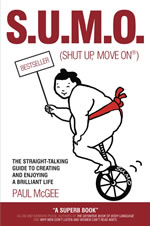
This morning we had great motivational speaker Paul McGee do some stuff with us based on his new book, SUMO.

Paul was engaging, lively, funny and quite deep in some of the stuff he shared. I’m going to find his book to have a read but he shared some stuff today which made me think on a personal level about how I react in certain situations.

Paul reminded us that outcomes are not just results of events, but results of how we react to events. I think this is correct as I can think back to when I have said ‘I had no choice but to …’ after an event has stressed me. I’ve also heard this excuse from others a lot of the time. But Paul reminded us that we are not like Pavlov’s dogs.

As humans, we are created in the image of God and as such we are distinct within creation. One of the distinctives is that we have free-will. Freewill means we always have a choice in how we react to a situation which means we can decide what we do when something else happens to us. AS we have a choice in how we react, it follows that we have more of an influence on the outcomes of the situations we find ourselves in.

Today was great – why not go check out the SUMO website.

building a new community?

This is a copy of an email I sent out on various networks a few months ago as a response to some encouragement from those praying with me.
It seems the right time now to post this in a more public setting:

I have been challenged over the last few months by two ordained people who have been mentoring me.
These two people have been listening and praying with me for a little while.
Their challenge and question – to start to research a new pioneering community now, and why am I waiting?

While doing this worried me – they have suggested I send out an email such as this and see what happens … so here goes!

I believe there are a few people, and the number will be small, who live, or soon will live, in Medway and share a common vision.
These people long, maybe are even too scared to dream, of church being a place which really connects with people outside, but also with them.
They dream of a church where differences are celebrated and add to the communities flavour.
They are not worried so much about what people believe, but more concerned about how people believe: how they live out faith, how they are Christ-like.
They don’t care so much about worship style, but interested in something that’s authentic and enables them to connect with God where they are emotionally and spiritually.
They really do believe Christianity is a journey, and that we can all exist at different points on the road, or even off it, with no fear of condemnation.
A community where it does not matter how they look, sound or by what they believe.
They want to see a community that loves and has people at its heart rather than a program that must be delivered.
They believe a community should be one that meets throughout the week to enjoy relationship with each other and with God, and is not restricted to any one day or meeting.
They are willing to pay the cost and experience the pain that comes with developing relationships.
They want to see this as a place where people belong because they are connected and on the journey, not a place where they can only belong if they turn up at a particular time, day and place.
They want to see a community that really believes in mission, that not only welcomes in strangers, but expects and allows the community to change due to what that new person brings with them.
They believe church is about participation and engagement of the majority, rather than being consumerist and led by a few specialists.
They are tired of being told the same stuff and want to discover together how to live Christian spirituality in their world!
They long for their experience of church to inform their experience of the world and vice versa.

This journey will be tough.
Not many will want to share it.
But a few will.
I am not looking for something better than we have.
I am looking for something equally valuable.
Something to add to the mixed economy of church.
But I’m putting this out there as I would really love to meet people that share this vision.
In particular…I am praying for 2 or 4 other people who share the vision as a start so that we can pray.

So … if you have something to add to this, please get in touch.

maybe you could pass this to various people who may have an interest?

Way to church closed!

Amusingly the road to the church holding the meeting this morning was closed.
The name of th road was Church Lane.
I needed to take a two mile detour to get to the church as the short 400 metre straight road was no longer accessible to me. It was all dug up!
There’s a message there I thought!

expressions

Today, at Kerry’s invite, I met with the Emerging Churches Group which is a group of practitioners who are all involved in some way in something new or different from Canterbury Diocese that meets twice a year.

I was quite surprised by the number of people I knew at the day, and it was good to meet up with Sha Coburn, Karl Rudd, Mike King, Eric and many others. It was great to have a brief chat with Diana who is the nightclub chaplain in Maidstone and it seems we have been hearing about each other for ages. It was also a privilege to hear from Bishop Graham and have a chance to pray with him before the end of the day.

Today was a day of hearing lots of peoples stories, some more innovative than others but all new in their contexts. Today was a day to hear from people who are attempting new ways of being church and it was good to hear some of these stories. It was an informative day and yet I had many questions about some of the day – and that is not a negative as we should be challenging, asking and not always necessarily agreeing.

It seemed to me that there was a lot of examples of new ways of DOING church, but not really new ways of BEING church. There was, for me, still too much concentration of ‘music group’ for worship and ‘speakers’ as it left me thinking we were taking an old format, packaging it differently and calling it a new way of being church.

I don’t criticise this, merely challenge the thinking, as all the evidence shows that these initiatives are growing and bringing people into a relationship with God for the first time. I believe, though, that we need to break further out of this mould of ‘a worship service’ and look to different ways of worship and learning that are more organically connected with those outside the church.

Marginal Identity

I had the privilege of speaking at Harvest this morning. I spoke of hope, and used Matthew 9:35-38 to illustrate how Jesus brought hope to communities.

As I was thinking on this I was brought back again to my thoughts last week of identity. To a post here, Darrel made an interesting comment which has been sitting with me for a while:

Identity is always stronger when you’re from, or perceive yourself as being from, a minority group. This is particularly the case if there is prejudice against this group either now or in the recent past.

I agree, but I also wonder whether we are not seen as a minority group already. There is certainly prejudice against what is perceived to be Christianity, and if this is so, should we not be seeing a stronger identity should already be developing.
For a group identity to develop does there need to be a minority, or a marginal, mindset. Before an identity develops, do we need to feel that others are against us? This seems rather negative, but many Christians do feel they are in a minority group and yet there is still a lack of identity.

I wonder if when a group moves from marginal to mainstream and returns to marginal again that the development of tat identity can no longer come from the marginalised feeling, but needs to come from a total re-think of what that group exists for?

I wonder whether what we are seeing now is a marginalised group that was once mainstream fighting hard to reclaim ground and ideals that are never going to return. The old ground has been lost (and I’m not so sure that is a bad thing)and there is a need now to claim the new ground before us.

Our identity cannot come from past events but from an agreement of a new paradigm and a commitment to re-assess where we are, who we are, and where we are going.

colonising our identity


A little while ago I blogged about the lack of a Christian identity. I was thinking on how we can develop a Christian identity and wondering what this may look like.

As I was driving back from chatting with Paul from Wycombe YFC Bjork’s voice whispered out of my ipod as she sang Declare Independence. A particular few lines made me think:

Damn colonists
Ignore their patronizing
Tear off their blindfolds
Open their eyes

Is our lack of identity a symptom of a type of reverse colonisation? By that I mean, have we colonised ourselves in that we have followed so much a missional line of thought that goes something like ‘we want people to see that, as Christians, we are pretty normal and enjoy normal stuff like everyone else‘. I question whether this desire to be seen as normal has resulted in allowing ourselves to be colonised by ourselves, to be like everyone else, which has resulted in a lack of an authentic Christian identity?

If this is so, what can we do?
As I listened to the track again as I sped down to the M40 towards the slow meandering M25, I wondered if God was saying ‘stop fighting and open their eyes, remove the blindfolds.’

Some Christians, in my view, have taken the ‘campaign for our rights route quite forcefully’. I have no problem with that, and I feel there is a place for it, but I do have a confusion in trying to understand that way of working, especially when we look to the Bible, or to the person of Jesus.

Jesus never seemed to stand up for God, or for himself. When criticised he took it and got on with what he felt was important (talking about God, feeding the hungry, healing the sick ….) Jesus did speak out, but instead of speaking for self protection, he spoke out for the poor, the oppressed and the marginalised. He never seemed to try and protect his position.

Jesus sought to remove the blindfolds, to open the eyes of those around to God’s liberating truth – the truth that God loves everyone and everything that he created. It’s the work that he continues in the communities over the world today.

I wonder if we reclaim our identity as we join with God in this ongoing work? Missio Dei colliding with imageo Dei fusing to create a Christian identity that inspires us. An identity which sees Christianity transforming society through actions of love, involvement, compassion and justice for others rather than voice seeking justice for ourselves.

What could this look like ?….. I’m not sure, I need to dream some more!
Hope (full) day

Today has been a day of good meetings where I have been able to chat with people I admire and respect and tussle over some theological type issues.

This morning I met for a long overdue coffee with Mark and it was good to simply chat over issues that are interesting to both of us. I don’t get this opportunity very often, but to analyse, think and wonder over key issues such as ecclesiology in a safe environment is always good – so thanks Mark!

After coffee we both made our way to the Gillingham Hope08 meeting. Recently some people from local churches used a simple questionnaire to ask people what they thought and enjoyed about living in Gillingham. People were also asked for their views on how the church could help the community. I was surprised by the answers. People want more clubs for young people and children, and drop in coffee shops for themselves. I was surprised by this as the churches already run loads of these, and it became clear that we are not very good at advertising what we do so that people can make use of them. So, to start with, Hope here is going to need to be about getting the info about what we are providing out to those that may wish to make use of the clubs and drop ins.

As part of Big Hope on Easter Saturday (Easter Eve) I have volunteered to pull together a stations of the resurrection art installation at St Marks Church. I’ve wanted to have a go at something like this for a while and I need a challenge! At the moment I think I have 8 of the 12 stations covered with people producing a cartoon, writing a song, painting, using computers and so on. I think the variety is going to be quite impressive. I’ll keep you posted, but if you think you’d like to be involved and take on a station either on your own or with a group of friends why not give me shout! Whatever … please pray for those involved as this is a first for all of us!

After the Hope meeting I met up with Den in a great coffee shop in Cranbrook. This was another time of chatting over some great stuff and sharing ideas and dreams. Thanks for the time Den.

I came away from my day full of hope, inspiration, enthusiasm and love.

I thank God for those lives that have touched and inspired me today.

grey or colour?

I was with Harvest again this Sunday and the questions have been developing in my mind. I had the privilege on Sunday afternoon to spend some time with Kerry and Eunice, the leaders of Harvest, and ask them stuff based on my observations.

One thing I have been particularly struck by is that Harvest is incredibly diverse. It does not just say it is inclusive and diverse, it actually acts out that inclusivity with an amazingly diverse group of people.

Within Harvest over the last few weeks I have chatted with conservative evangelicals, liberals and anglo-catholics who all seem to be able to co-exist and travel together on this journey called Harvest.

It’s good to see a church which practices what it preaches. It speaks of acceptance and the importance of relationships. Because Harvest takes this seriously being on placement here has actually been a bit of a nightmare as there are no real structures.

Harvest consists of cells who are committed to traveling together with each other and God. There is no statement of faith to subscribe to, no one ‘flavour’ of doctrine and no set way imposed or encouraged by the leadership.

I do have some issues and questions with this. I have questions around where do we draw a line with our inclusivity. How do we maintain with integrity a Christian identity and outlook if we are being inclusive of everything? If we draw a line, what criteria do we use to hekp us to know were to draw that line? In cells how do we ensure and maintin some form of quality control if the lead given is a light touch? The desire to be inclusive can result in being exclusive as people observe and believe they see nothing of the authenticity for which they are searching and so pass on.

Is an inclusive community, which sounds great in theory, really seen as quite bland and nondescript. Do we think its colourful when all that others see is an undefined greyness.

These are questions that have come to me on my drive home, and ae the questions I wish I knew beofre and could have asked Kerry and Eunice …. ah well, next time!