God in the darkness

Today I traveled to the Franciscan Friars house in Canterbury to meet up with Brother Colin.

For the next year Brother Colin, a wonderful Franciscan Friar, is going to be my spiritual director. If we both believe its working after the year we will agree to continue.

This morning Brother Colin got me thinking in a number of ways but one in particular followed our discussion of morning and evening prayer. For many years now I have been following and using the daily office from the Northumbria Community. For the last few months, in line with requirements of ordination, i have been using Common Worship for morning prayer. I can’t pretend to be totally comfortable with this as it is over wordy (in my humble opinion) and I resonate far more with the Northumbria liturgy.

As we discussed this Br Colin reminded me of the daily cycle. We know that God’s people saw the day starting at sundown. I was aware of this , but not really fully thought through what this meant.

If the start of the day is when darkness starts to descend, and God created that day, and lives within that day he created, then God is in the darkness as well as the light. It’s easy to think of ‘other powers’ having some rule over the night, or subconsciously thinking God is not in the darkness. Part of Israeli faith, and the first century faith of Jesus, saw very much that God was everywhere, including the darkness.

That brief conversation has opened up a whole new dimension of God for me. I’m now wondering how you recognise God in the darkness!


Chronos vs Kairos

Over the SEITE weekend Brother Patrick Moore caused us to think about time differently. He outlined two sorts of time.

The first of these was chronos, from which we get chronology that divides time into past, present and future. This is how we commonly think of time. It was interesting to hear Brother Patrick outline how with chronos we can be in more than one place at a time – a kind of confused Dr Who style Time Lord. At times during Brother Patrick’s lecture although I was physically present in the room my mind drifted ahead to the future and sometimes back to the past and so it could be argued that I was in all the spheres of chronos in a short space of time.

This is as much a play on words as anything else, but I enjoy thinking in this way.

Interesting and challenging, as well, to realise that because God cannot be constrained or divided that God, as such, cannot exist in chronological time. Chronological time, itself, is too limited to contain God.

Kairos time is exclusively time in the present. For me, personally, Kairos time can occur in front of my computer screen or very easily when sat on a beach gazing out to sea. Kairos stays in the present because we lose track of time, when asked ‘how long you been sat there’, our honest answer is ‘5 mins? 20 mins? … 2 hours? … I dunno!’ Kairos time is a waste of time, but a waste of time with God.

Prayer is wasting time with God.

Kairos time is what Jesus was talking about when he challenged his disciples to not worry about the future or the past, but to live in the present. God is called I am, not I was or I will be – there is a clear emphasis on the present. It’s not easy to forget the past or to be impartial about the future; but I suspect there is more of God to be understood if we can grasp the Kairos thing.

Trinitarian Dance

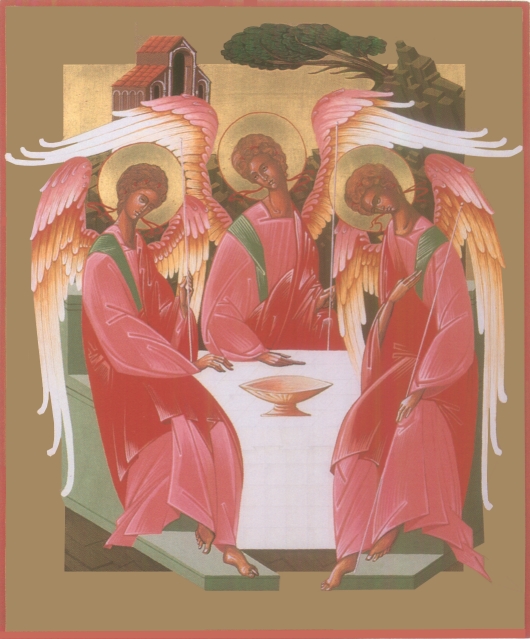
Ian links to this post on periochoresis- the idea that God dances together in Trinity.
The article is a good read.

I wrote an essay on this around a year ago and remember being struck by the idea of God creating out of this Trinitarian Dance – a dance where each part of the Trinity moves in intimate relation to each other. I was struck by the thought that God exists in relationship. That may be obvious to you, but I had not really thought about it. Yes I knew all about the 3 parts of the Trinity, but I guess I had compartmentalised and seperated them.

I concluded that as God lives and creates out of this dynamic relationship, that we, as humans, need to be dancing in dynamic relationship with God and others (a secondary trinity of God, me and you?)to live and create as well.

is God even there?

I met up with good friend Chris today for lunch and we started to chat about (amongst other things) the sacred secular divide.
I agree with Hirsch saying ‘our task is to make all aspects and dimensions of life sacred—including family, work, play, conflict, etc. and not to limit the presence of God to spooky religious zones.’You can read more here.

I feel that there cannot be any sacred and secular divide as there cannot be anywhere where an all powerful God cannot be. If that is so, and I believe it is, then everywhere is sacred because God not only created it, but God is there.

Chris asked an interesting question: ‘What about in a meeting of a witches coven?’. That’s an interesting question I thought. My immediate impulsive answer was a ‘no’ but then …I believe God must be there … for there can be nowhere where God is not … but I do wonder what God is doing there … is God watching? crying? sighing? wishing? or what?

made me think

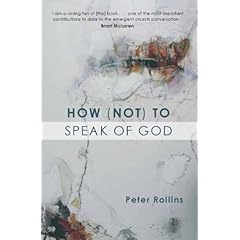
How not to speak of God by Pete Rollins was one of the best theology books I read last year. It is an engaging and provocative read which challenged me to think beyond what I have thought of as orthodox teaching.

You can get a flavour of Pete’s thoughts on this post called Turn the Other Cheek.

Study day

Today I have been disciplined and had a bit of a study day – I’m supposed to take half a day a week, but keep forgetting as work is so much for more fun than the thought of study at the moment.

Sadly my placement at Moot is coming to an end so for part of today I reflected on what I will take away from my experience with the Moot community and wrote it down in my assignment which was due in …. errr a few weeks ago – but I do have the excuse of starting my placement late and finishing it late.

Two things have hit me massively from this placement over the last 5/6 months.

The biggie for me is how Moot is genuine community. Being part of this community has been an amazing experience. There is true acceptance here and a real desire to enter into dialogue with each other, learn from each other, and make use of each others gifts.

I have also been struck by Moot’s ability to have a ‘both/and’ model by holding redemption and incarnational theologies in their outlook as they look to avoid extremes which alienate and consider everything which allows a fuller engagement with culture and God. Bevans labels this a synthetic model of contextual theology.

I’m sure I will learn more as I reflect longer over time, but I’m going to be sorry to be leaving Moot as part of my placement – but I shall remain part of this community.

Eucharist

At SEITE for the past few weeks we have been studying the origin of the Eucharist, which has been quite interesting in many ways.

It strikes me as quite interesting that Cranmer produced a liturgy to enable people in the 1600’s to be able to take part and understand in the Eucharist itself. The language was normal everyday language (the vernacular) for people living then. My question – why do churches still use this in their services some 400 years later? I wonder if Cranmer meant for this to happen, or would he scratch his head in confusion at seeing people use his wonderfully coomon language of the time being used in the way it is today to give an impression of a far off and irrelevant God?

By all means lets keep the structure and some of the ideas; but surely it needs to be reframed for a postmodern era and developed into a form with resonates with people where they are today.

It has been interesting looking at different views based around what happens with the blood and wine. Discussions around does it change into the actual blood and body of Christ transubstantiation), is it just symbolic (a visual aid as Zwingli says), or is it somewhere in between – being symbolic but more in some way. I think I’m with Zwingli here, but with a plus – God is present in some mysterious way which is achieved without the bread and wine actually turning into flesh and blood.

I must say I have struggled with some of this. It’s not that I have difficulty believing Jesus is somehow prsent in the elements, the bread and wine, of the Eucharist – my problem is believing God is present only there. God is present in the creation, God is present in the normal every day actions of people, God is present in the fantastic art of the world. In light of this, my problem is understanding how God is present in a unique and different way in the bread and wine.

Surely if we are saying he is particularly present in a special way at Eucharist then we are saying the prsence of God in our normal everyday lives is somehow a second class presence. Is that what we are saying, and is that what we are meaning?

Any comments?

split personality sunday

An interesting day where I have wondered at the church and whether it can cause a split personality.

Today I have been in 2 locations, both being Anglican in nature.

This morning I led worship at St Marks. I think what we did seemed to work well. I think I was very Anglican and we had a lengthy time of sung worship, as that is what a number of St Mark-ers like to do.

This evening I sat in an excellent MOOT service thinking about accountability. There was no singing, it was very meditative and held in a building from the Anglo Catholic tradition.

Both were great, both were very different. I was challenged in both in completely, but certainly not totally separate, ways.

During the drive home I started to reflect on where God’s role for me is going to be taking me in 18 months time. Today I experienced worship that was poles apart (although not extremely apart), and I enjoyed both and see that both are needed and are appropriate. Whether both are usually appropriate to the same person should not be strange as we all have different needs and preferences at different times.

Looking ahead, I am not sure I wish to be pushed to a pole, to an extremity or right to the edge. That does not seem quite right. I think that being at extremities is dangerous and can result in harmful practice, maybe even to eventual heresy. It is also at these extremes that I seem to find people who think they are right and that everyone else is wrong.

One of the things I have loved about MOOT is that I have not met anyone like this at all. The community enjoys its style, but it is the most open community to change that I have ever been involved in I have not met anyone who thinks they are totally correct. I have only tended to find that attitude amongst people in the established church(es).

The extremes of worship need to be held in tension, but also I wonder if we need to find a both/and middle ground. Do we need to be either charismatic or meditative, can’t we be both? Do we need to be evangelical or liberal; why can;’t we be both?
Why can’t we have a unity in our wonderful mix of diversity?

God of rules or compassion?

Last night we touched on an interesting situation in acceptance within church.The scene was of someone from another religion, in this case a Hindu, coming forward for communion at a service. Someone immediately said they would not give communion to someone who was not baptised. My immediate reaction to that was a ‘no’ as that would exclude many Christians I know, not least many in denominations like the Salvation Army.

But what of the situation … should the table be open to all, or should we have rules that people need to meet before they can be included and take part? It’s an interesting question and it was clear we were not easy with the situation and had too little time to talk it through properly.

During the short chat I thought of Cornelius from Acts 10. All the rules said this man should not be included. Peter was breaking the rules and customs by even going into his house! Yet … this man, and others present, were filled with the Holy Spirit when all the rules said they should not have been.

God chose to break the man-made rules in their attempt to box Him into a containable, controllable form! As a result, Peter suggested they should baptise Cornelius and his household and visitors as God had already worked!

Maybe sometimes our ‘rules’ need to be considered in the light of compassion and what God seems to be doing.

EOT and orthodoxy?

Tonight was the last SEITE session for the year.
We did our Pelagius vs Augustine debate which seemed to go quite well.
We then went on to look at orthodoxy and heresy generally and on pondering I wonder about what is seen as orthodox.

Does orthodox mean everyone having to believe the same thing with no room for questioning? Is it about deciding who is in and who is out? Is orthodox thought for ever or can it change with age?

For example – Augustine seemed to think of original sin and new-born babies condemned to hell because he had a view of conception based on Aristotle’s thoughts; i.e sperm contained humanity and the womb was just a vessel for growth. So he believed, on which he based his orthodox thought, that all attributes of a baby were passed down from the male. An idea that we now know to be incorrect. With the knowledge we have today would Augustine have thought differently about this one part of his orthodox thought?

So can something that was an orthodox in an age, become unorthodox is another?

Time to think …