
if it doesn’t look like Jesus, it’s not God!

imagesThis may come as a little shock … but I have avoided a lot of the mainstream evangelical mass produced Christian stuff over the last couple of years. I have done so because a lot of it simply leaves me feeling sad. What I interpret, read and hear as a lot of legalism of how one should act, dress, believe and behave worries me as I try to follow a God who is full of love, grace and acceptance.

Rather than being sad I smiled with delight when I came across this article in Christianity magazine by Steve Chalke. Some people will read no further because I am linking to Steve … it astounds me that a large part of the evangelical church here can, one minute hold someone like Steve up with pride and then, when he starts to challenge their thinking, dismiss him and refuse to take him seriously, even accusing him of being a heretic.

I loved reading Steve’s article as he simply asks us, ‘have we misread the bible?’ For a long time many have been saying so … but Steve is one of the first to stand up from within evangelicalism and challenge some strongly held, and in my opinion wrongly held, evangelical views. Steve challenges us to take the whole Bible seriously, and not just keep pulling out parts that support the argument we wish to represent.  ‘If we fail to take the whole bible seriously including those bits we find unpalatable or inconvenient’, says Steve, ‘we only pay lip service to its authority’. Despite what some might say, Steve is not watering down the Bible, but the exact opposite – he wants it taken in complete seriousness!

One important aid to interpretation that I loved comes from a simple saying, ‘if it doesn’t look like Jesus, it’s not God’. Jesus is both our guide to biblical interpretation and to life.

Last week I came into a conversation with a Christian man arguing with a young woman. He was quite foul in his attitude and language on top of extreme sexism and unpleasant racism thrown in as well. He backed his views up entirely with scripture … but my problem was … it didn’t look one iota like Jesus. The man expressed an ugly unattractive legalistic view of faith. It did not look like Jesus, so how can it of been God?

As Steve draws out the bible does not give us answers to a number of spiritual and moral issues. our task, as Christian community then, is to wrestle with the meaning of these words both honestly and humbly.

On a different, but very related note, I loved this article on Rachel’s blog. The way the bible has been misinterpreted to control and abuse woman has been something that angers rather than saddens me. Rachel’s article is cleverly written, light and humorous … but with a seriously deep challenge.

You see… this whole thing of taking stuff out of context and forgetting what Jesus is like means we become distorted to the point of ugliness in how we act as Christians. If we don’t look like the Jesus of the gospels then there is something seriously wrong … and when Christians stand outside clinics or airports with foul signs of hate and intimidation …. then something is very seriously wrong.

So … go read the articles – Steve’s here and Rachel’s here.

Then …. come back … and talk … there will be some of you that disagree!

breaking hearts

c5b03c1aaffd6856dcbe153071d9b430I stumbled upon this excellent quote from CS Lewis on my friend Grahams blog:

‘To love at all is to be vulnerable. Love anything and your heart will certainly be wrung and possibly be broken. If you want to make sure of keeping it intact, you must give your heart to no one, not even to an animal. Wrap it carefully round with hobbies and little luxuries; avoid all entanglements; lock it up safe in the casket or coffin of your selfishness. But in that casket—safe, dark, motionless, airless—it will change. It will not be broken; it will become unbreakable, impenetrable, irredeemable’.

At first sight his talks about the vulnerability of love … but if we are called, or created, to be in relationship with each other … CS Lewis is really talking about the vulnerability of any human relationship. A raw vulnerability that may well result in a broken heart.

A broken heart at first sight, again, seems to be a bad thing. But in my vulnerability thinking I have started to wonder if this is really the case. To grow in love, in care and in understanding needs a willingness to be vulnerable, and I am not sure true vulnerability happens without the heart being broken now and again. Actually I wonder whether the more the heart is broken and the more we allow God to impact it … that the better that must be.

As I have looked over Gillingham this past year and the lives of some people that I am amazingly privileged to have been involved with …. there have been occasions when I have wept for people and situations. I wonder now if my heart broke for them. At feeling the pain between what is needed and what will happen my heart has been broken because I have realised the pain won’t go … and that all I can do is stand and hold the pain with them. To stand in the crap of life alongside them and stay with them as they deal with it.

I have prayed to God to change things …. and God has reminded me that we are supposed to be the hands and feet of our creator. Being hands and feet of the creator is inevitably a pretty messy and painful experience. An experience that breaks hearts.

As I have been rolling this over and over in my mind, I stumbled on this video on WOTP. In this there is a discussion between Brian McLaren and David Wilcox. The opening question in this video is ‘what breaks your heart?’ Wilcox answers this with ‘the gap between what is needed and what I carry’. I think I relate to that and think he explains the feeling I have above better than I ever could do.

McLaren is amazingly honest and replies ‘I don’t think my heart gets broken enough anymore.’ He seems uncomfortable by this admission, and it causes me to ask and challenge myself in that area.
How much heart breaking is enough?
Is there a point when it becomes too much?
Does allowing our heart to be broken ever become unhelpful, or does it just inspire us to keep going further?

Anyway … I find Graham’s words and this video quite challenging … so why not check them out.

Examen the weekend

dissonanceIt’s been pretty much a weekend of blessings.

But … it’s interesting to note that when you immediately look over a weekend that often the bad things jump out and flavour your thoughts… the bad things like the dog is now terrified to go on his walks and just freezes and stands still. While it is really sad and horrible to see our once very confident walk loving dog standing still and trembling, we are hoping that with gentle encouragement this will improve.

But … good things happened this weekend …

On Friday afternoon I got to have a great chat about the important stuff with a good friend in the pub.
On Saturday the Gills won 2-0 … easily … against arch rivals Swindon!
Saturday evening we had a great meal with our next door neighbours.
On Sunday my little brother came to lunch with Tanya and Jack
Sunday night I went to the United Service which was great as we looked at how we could work together better to help the people of Gillingham.

I have been able to pull myself away from the negative this weekend and allow the positives to take over. This, I think, is because I use the Examen. Using the Examen as part of my personal rhythm of life allows me to see the day in a better balance. It allows me to think through in which situations or conversations I felt alive and in which situations I feel drained or depressed… (and where God is in both) and to try to balance my days in the future accordingly. For the geekier amongst us there is now an Examen app (thanks Jonny) which I am trying out …. seems ok too!

The Richard Rohr daily mediations also help me in this and have, in my opinion, become even more amazing over the last couple of weeks due to a change in format. On each Saturday an email now pops into my inbox which sums up the week and leads me through a sabbath meditation to earth what we have been contemplating through the week. If you are not signed up for these … well you should be because they are pretty amazing!

sunshine connections

I really enjoyed the RochesterFilm Society showing of Sunshine on Leith this evening. This was a fun, feel good movie, which, to be honest, was great to watch after the events of this past week.

Some did not like the connection between the story and Proclaimers music, but I thought that worked pretty well. The performances of Mullan and Horrocks alone make the film worth seeing, but there is so much more in this than two talented actors.

I liked the way the film portrayed the fragility and centrality of relationships. In this film, to be human is to be in relationship, or to be connected in some way, to another human being. Even though relationships were key to humanity, they are shown to be very prone to cracking due to human behaviour and misunderstanding.

In this film, relationships are what life is all about, but they only work for the people who are prepared to fight for them. Whether it is a parental, lover or friendship (all three are illustrated in the film) ‘Sunshine’ almost wills the characters to chase the relationship as away to show its value and importance. For relationships to flourish … vulnerability was needed. For some reason I connected with that in tonights film!

All that for a shallow musical …. thanks RFS for giving me an excuse to come out of the house and experience this for a while.

vulnerability is not a weakness

VulnerableMore Brene Brown today following this messy subject of vulnerability.

As you will know I have been mulling this whole topic over for a while now. Back in March I was thinking but put tuff on the back burner. More recently the subject has come up in talks, in reflections and in my general life.

As a ‘leader’ training for ordination I remember an experienced priest telling me I needed to be less vulnerable. I disagreed. In the last few months I read an article on church leadership that says being too vulnerable is dangerous. That sounded wrong and I disagreed.

And then I came across the stuff of Brene Brown; who seems to view vulnerability in a whole different way, but in a way that chimes with something deep within the caverns of my being. As I hear her words and consider her comments on vulnerability I feel something ringing and awakening deep within my being. It is, though, an uncomfortable awakening, an awakening that seems to demand my attention and energy!

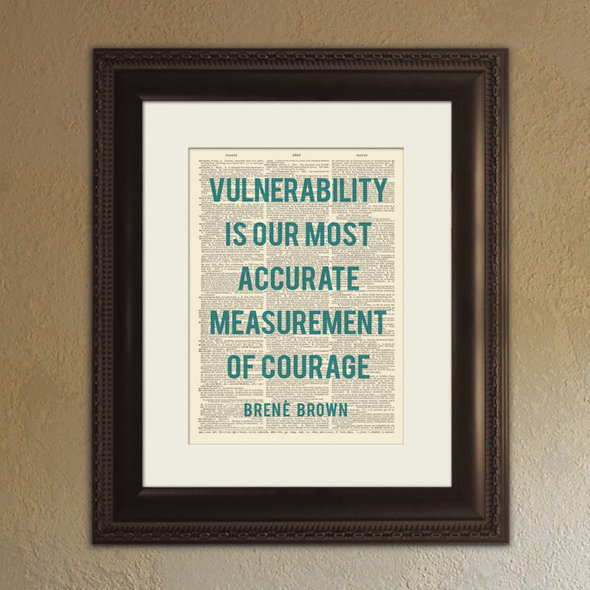
Early in the video I heard the statement ‘vulnerability is not a weakness’ but rather it is the ’emotional risk that fuels our daily lives and our most accurate measure of courage’.

Vulnerability, says Brown, is ‘the birthplace of innovation, creativity and change’.

In other words … you cannot innovate, create or cause change without making yourself vulnerable. To step out and create demands a risk of us, it invites failure. In my creative stuff i have noticed most ideas and writings do not work first time, or even second, or third, or fourth ….. the creative process, the change process, involves a massive amount of failure until something starts to work.

Look at Edison. He tells us that he tried over 1000 times before he got the light bulb that worked. That’s some failure! That’s great vulnerability. That’s great conviction and faith, and some absence of a fear of failure! So, vulnerability, it seems is not only vital in friendship and relationship, it is a vital ingredient in the creative process.

If we cannot be vulnerable (in this sense unworried by failure), then we are hindered in our creativity and our desire to see change.  It seems to understand vulnerability, though, we need a sense of shame. I’ll let Brene Brown explain:

a new kind of vulnerability?

vulnerable spider(Disclaimer … I’m not sure this makes sense and I’m kind of thinking aloud!)

It’s not been a great weekend. The last few days have got me thinking  a whole new take on vulnerability.The vulnerability of feeling useless and powerless to do anything while seeing something horrible occur.

Earlier this week our dog was attacked by another dog. It was horrendous for my daughter who was walking him with a friend. We had to rush our dog to the vets, he stayed overnight and is back with us but with 30 stitches in his neck and ear and 4 drains coming out of wounds, with a few more visits at the vets lined up.

As we gaze at the injuries, our feelings of uselessness to help or relieve the pain seem to be linked in some way with a sense of vulnerability in ourselves. The fact that I can do nothing itself leaves me feeling very vulnerable for some reason …. and I do not know why!

So … in my reflection I am mulling over the wonder of whether there are different kinds of vulnerability. Or … are there a variety of triggers ‘out there’ that cause us to feel vulnerable to what is around us? It’s an interesting question because, with my logical thinking head on, there is no reason for my feelings of vulnerability! I could understand feeling sickened, or angry or wanting revenge …. but feeling vulnerable is quite uncomfortably odd.

I am wondering if the feelings of vulnerability come from a mind that likes to ask what if …. what if he had attacked the girls walking the dog, what if he had attacked me, what of we had left 10 minutes later, what if they had opened their front door 2 minutes later ….  I guess ‘what if’s’ remind us of a certain fragility of our life journey. We like to live and believe, subconsciously we will be around forever. But maybe a sudden shock reminder of our fragility fuels the feelings of vulnerability. It’s easy to feel safe when you believe you are in control. When something unexpected and horrible happens that we can’t control, it is then when the feelings of vulnerability flood our emotions and sense of thinking.

(you did not expect this post to make ANY sense did you? … I did warn you!)

Maybe, of course, my mind is mistaking great sadness, and emotion, and anger with the feelings of vulnerability? I could see that making some sense, although on reflection I’m pretty sure that is not the case. Vulnerable is what I feel and I don’t know why.

To top all of this, I think being vulnerable is important to our personal growth … but maybe there is an unhelpful sense of vulnerability as well, maybe some types of vulnerability are not helpful …. more reflection needed … so I’m glad I’m giving myself the whole year for this!

Any insights, please comment!

A BRAND new PRESIDENT?

Along with many others I have been struck, challenged, intrigued and maybe even surprised to hear the Jeremy Paxman interview of Russell Brand. If you have not heard it, it’s really worth listening to, and actually reading the rest of this post would make little sense without hearing the interview first.

http://www.youtube.com/watch?v=xGxFJ5nL9gg

I love what Brand says. I literally was nodding and saying an audible yes throughout the interview. I share his frustration … and coincidentally for the first time in some 30 years I have not renewed my membership of the Labour Party. In the words of Brand, I also have become ‘weary and exhausted with the lies, treachery and deceit of the political class’. There are some good politicians around … if we talk MP’s though, locally I can only think of two – one being Paul Clarke who was Labour MP for Gillingham who is still working hard to help the local area, and the other being Tracey Crouch who is the Tory MP for Chatham and does not seem to be afraid to speak out for her constituents even when it is contrary to party views. People like Paul and Tracey seem the exception to the system. It does seem that whichever party takes the helm, the rich poor divide and fair distribution of services is rapidly deteriorating.

Brands words intrigue me. When Paxman challenges him over not voting as ‘that is how democracy works’ his response with the ‘well it’s not working very well’ is hard hitting and accurate. When Paxman asks him what he would do instead, Brand can only respond from the perspective of what he would not do.

Developing an alternative system when all you have known is the current state of how things are done is really tough and difficult. (as a pioneer trying to birth new church when all we have known is church can relate to this dilemma. But, that’s a post for later in the week)

A good friend pointed out to me earlier in the week that, actually, what Brand is calling for in his revolution is, basically, a call to a society based on Christian values.

Now before my friends of other faith and no faith sharpen weapons to attack me … hear me … I’m not saying everyone needs to believe and follow Jesus and society will be great (although I think it would be!) …. that would be a Christian society …. but a society based on Christian values is something different … A society can agree to live by Christian values of love, respect, honesty, equality, compassion etc simply because those things are good in themselves for the betterment of society.

These values would mean we had
A caring society where the planet is not being destroyed through selfish exploitation
A fair society where we do not create massive economic disparity
A compassionate society that takes account of the needs of the people

A society based on fairness and respect and love and care and compassion, with a desire to see everyone flourish and everyone to reach their potential with the view that community, not certain individuals, is what it is all about ….. that’s an alternative worth pursuing. An alternative that Jesus called for through the beatitudes:

When Jesus saw his ministry drawing huge crowds, he climbed a hillside. Those who were apprenticed to him, the committed, climbed with him. Arriving at a quiet place, he sat down and taught his climbing companions. This is what he said:
“You’re blessed when you’re at the end of your rope. With less of you there is more of God and his rule.
“You’re blessed when you feel you’ve lost what is most dear to you. Only then can you be embraced by the One most dear to you.
“You’re blessed when you’re content with just who you are—no more, no less. That’s the moment you find yourselves proud owners of everything that can’t be bought.
“You’re blessed when you’ve worked up a good appetite for God. He’s food and drink in the best meal you’ll ever eat.
“You’re blessed when you care. At the moment of being ‘care-full,’ you find yourselves cared for.
“You’re blessed when you get your inside world—your mind and heart—put right. Then you can see God in the outside world.
“You’re blessed when you can show people how to cooperate instead of compete or fight. That’s when you discover who you really are, and your place in God’s family.
“You’re blessed when your commitment to God provokes persecution. The persecution drives you even deeper into God’s kingdom.
“Not only that—count yourselves blessed every time people put you down or throw you out or speak lies about you to discredit me. What it means is that the truth is too close for comfort and they are uncomfortable. You can be glad when that happens—give a cheer, even!—for though they don’t like it, I do! And all heaven applauds. And know that you are in good company. My prophets and witnesses have always gotten into this kind of trouble.

That’s a kind of society I wish to vote for …

don’t stop … you might find yourself!

DSC_0042On Sunday evening some of the gathering got together in a local pub to have a go at writing our first aspirational statement with practices or ‘the how’ we will attempt to live our lives.

It would be wrong to put ‘out there’ the statement and points we came up with at this time as they are draft and for the whole gathering community, rather than just a part of us, to agree, but I think it is ok to say that our first statement, or value, is one of ‘sanctuary’ as outlined here

Interestingly we chatted round the language we used and I think we were able to come up with something that is quite inclusive and welcoming of others. An issue we had was of producing something that demanded some form of commitment from us while avoiding some bar set so high that it became a chore and probably unachievable. This is a very exciting, if challenging, time for us as the gathering as we continue with this process of developing our rhythm of life. 

The more I have thought about this topic of sanctuary, the more I am coming to see that sanctuary could be quite a key element to both a personal and communal faith and lifestyle. Every rhythm needs space, and rest, and reflection, and contemplation …. As many know I have an allotment. The seasonal work of an allotment means that there are varied workloads and, quite importantly, a period of rest while stuff dies or hibernates or retreats to within until it gets warmer. Without the rest in the seasons the crops would not be able to grow while without the rest and variety of activity, the allotment keeper would die!!!

I find the more I look at the 21st century world the less I see of sanctuary. People, generally, seem to want to pack more and more stuff into their lives. I read the words of someone recently (I can’t remember who) that said thy cannot cope with space and silence and need to fill it. Rather than be silent this person would rather count the stars I think they said. 

The question I ask of such a person is, ‘what are you running from?’ To shy away from space and silence seems to indicate to me a reluctance to rest with oneself. I think the person who avoids sanctuary or rest or silence or space is running from themself out of a fear of what they might find if they stop. 

As a rule in a post modern consumerist society … do we run from ourselves out of a fear of what we may find? As created beings, made in the image of God,I wonder if maybe if we spend time with ourselves we might be amazingly surprised … as we take space and listen we may well hear something of great value …

…. maybe …


deliberately cracked

crackvase_litex3The retreat was an excellent time away.
Bishop James was fantastic in his teaching, which was based around 2 Corinthian chapters 2 – 6., and challenge. A really powerful time for me personally was on the last morning when in the context of a Eucharist, Bishop James prayed for each of us and then anointed us as we re-affirmed our ordination vows. This experience took me back to the roots of why I do what I do which was in itself a real personal challenge to me.

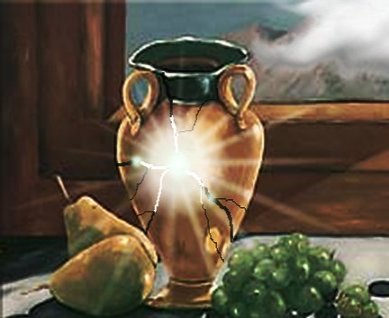
The most encouraging moment for me came when Bishop James reminded us that we hold our treasure, our ministry, within jars of clay (2 Cor 4:7-12). These jars are jars that would be picked up at a local market, poor quality, thin, designed for everyday use … maybe even cracked. These are not the good quality thick earthenware jugs that would be adorned with patterns and motifs. The bishop pointed out that Paul states figuratively that it is in these everyday poor quality clay jars that we carry the message of the gospel in. Paul was saying, and the bishop was reminding us, that Paul likens our lives to those poor quality jars. Jars made so thinly that you could see a candle shining through them.

That encourages me because a lot of the time I feel broken but don’t feel the need to be fixed, even though people sometimes want to fix me.
It encourages me because I know I am full of cracks and imperfections, but don’t feel a need to fill or glue them with something else, even though some may feel thats the right thing to do.
It encourages because I know I ain’t one of those pretty jars …. but God created me in the image of God all the same.

I’m encouraged because I have believed for some time that that my being broken and cracked and transparent is right. I believe this because I think that it may be through the cracks, the thin-ness and the transparency that the light of Christ shines through.

If I was perfect and my life was solid and sealed nothing would escape or leak of seep out from the imperfections. So …. I remain deliberately cracked because I believe I was deliberately created that way.


It’s how you believe …

Aside

A challenge from Richard Rohr’s meditation today: Wimagehy is it that Mother Teresa could stand up before crowds of thousands and repeat simple New Testament phrases and seemingly pious clichés, and still blow people away?!

She didn’t say anything new: “Jesus loves you,” she assured us. “We’re all sons and daughters of God, and we have to love Jesus’ poor.” Yet people walked out renewed, transformed, and converted.

She wasn’t a priest or minister. She wasn’t well educated. Her authority came from her lifestyle, her solidarity with human suffering, and thus her pure goodness.

Loving servanthood and foundational surrender are the true basis for teaching authority in the Church, much more than title, vestment, role, or office. Such lives have the living authority of Jesus himself, and need no special ordination or public validation. Jesus says to Simon Peter that he, and we ourselves, must first “be sifted like wheat,” and only then are we in a position “to recover and in turn strengthen others” (Luke 22:31-32). Such undergoing is the seminary that finally matters and that changes others’ lives. It was Jesus’ essential and first “recovery program.”