Advent 18: be seeds of transformation

“The kingdom of heaven is like a mustard seed that a man planted in his field.
That seed is the smallest of all seeds, but when it grows, it is one of the largest garden plants. It becomes big enough for the wild birds to come and build nests in its branches.”

I think it is true that many of us look at injustices and wish things were not as they were.

Most transformations in society occur when a community decides to bring about change. If that is to happen, usually an individual has to make a stand and take the initial step of speaking out, or asking a question, or writing a letter. That tiny act, or seed of transformation, starts to grow as others with similar views join the initial person and a community of transformation is born.

AS I think back to the Burma protests I am intrigued as to how it actually started. Who was the first monk who dared to speak, and in doing so risked condemnation, oppression and even death. How did that monk feel?

If individuals do not speak out, things do not change.

As a Christian I am challenged to think about those instances where I have not spoken out, or taken a stand. Those times when I’ve known what the right thing to do is, but have chosen to ‘choose my battles’ and stay quiet. It’s honestly disturbing my complacency as its easy to pretend I’m living quite well if I do not reflect on how my life is in reality. I’m wondering whether the adage of ‘choose your battles’ is a cop out?

The words of Edmund Burke have been echoing in my head today:
“The only thing required for evil to triumph is for good men to (say and) do nothing.”


Advent 17: true worship?

Todays thought again thinks around a more inclusive, or varied, interpretations of the Bible.

Just as God is unimaginable mystery, so too none of us can proclaim to have a total grasp and understanding of the Bible. We cannot camouflage the Bible’s message by saying that our interpretation is the only true interpretation.’

If the Bible is truly the word of God, how can we ever hope to have the one true interpretation of that word? I would suggest that at best we may glean some understanding for a certain time and a certain place and a certain situation.

A while ago at a YFC staff conference the speaker started his talk with roughly these words: ‘I don’t preach the truth. I preach my opinion of the truth, and if other preachers realised that about their preaching maybe we would have less problems in the church!’

To claim we have 100% truth in our interpretation sub-consciously dismisses our need for God; in fact maybe it even replaces our need for God. If we feel we have total truth, then we no longer have use for a God who we are answerable to, a God who we worship, a God whom we expect to continue to speak truth today. If we claim 100% truth, maybe we stop worshiping God, and start to worship truth – or our interpretation of truth!

Advent 16: dangerous God?

Creation does not define God. Creation points us toward God.
Does the amazing diversity of creation express the love of God?

The diversity of creation must include creation in its entirety.
Today’s Advent thought considers whether all encounters with God that we have leave us ‘leaping for joy’. Looking to encounters such as the transfiguration shows that such experiences may also be shocking, terrifying, confusing or even concerning.

If we look on the whole of creation as an expression of God’s love then how is that being expressed in the sting of the wasp, or the kill of the great white shark, the short life of the butterfly, or the devastation tornado?

How do the confusing, startling, surprising, painful sides of the creation point us toward God?

Advent 15 gender freedom

Todays Disturbing Complacency thought thinks more on the language we use to describe God. It amazes me that people can still become so concerned over the use of feminine language to describe God.

God is ontologically different from creation and, as such, any language that we as humans, being part of God’s creation, use to attempt to describe God will always be incomplete. We can only describe using concepts we have grown up, and God is way outside the constraints of any of those concepts.

God is not a human and so God does not have gender. When we speak of God as Father we are saying God has fatherley characteristics, but we are not saying God is male. When we speak of God as Mother we are saying God has motherley characteristics, but we are not saying God is female.

Gen 1:27 has always made this clear for me: So God created man in his own image,
in the image of God he created him;male and female he created them. People who speak against female images of God seem to disregard texts such as Is. 66:13 As a mother comforts her child, so will I comfort you and Matt. 23:37 O Jerusalem, Jerusalem, you who kill the prophets and stone those sent to you, how often I have longed to gather your children together, as a hen gathers her chicks under her wings, but you were not willing.

If we are more inclusive in our language, and more open to a richer description of God then maybe we have a better chance of understanding more of our creator.

Advent 14: colony or community

The second week of my Advent thoughts draw to a close with reflection on the possible current presence of colonialism in our Christianity.

In mission studies we may look back to the past where the methods and expectations of well meaning missionaries was corrupted by colonialism which outplayed in the expectation that the new Christians of whatever country would all act like western Christians did, disregarding indigenous culture or experience.

As my day draws to a close, I’m not sure that as western Christians we have moved on too much from our Victorian ancestors. From where I look it does still seem that in church, on a Sunday in particular, we expect all people to behave the same way and have the same worldview that we have as well as the same ‘brand’ of faith.

If church is community, then a diversity of opinions should co-exist in an atmosphere of mutual trust, respect and love. As the community considers each other, each person hears and reflects and changes. The result is that the community grows in its spirituality and gains a wider, fuller and deeper relationship with each other and with God.

The alternative is a bland, mono-flavoured colony.

I wonder if we are afraid of difference and diversity because it may cause us to challenge ourselves on how we think. If we think or question too much, we may find out that our current view is wrong and then need to change our opinion. Changing our opinion may need us to change our lifestyle, our practice, our church.

Much safer to colonise!

Advent 13: life or death?

Todays Disturbing Complacency thought has been digging away at me all day.

What if it was not Jesus’ crucifixion that saves us?
What is it was the way he lived his life that saves us?
Is it possible that Jesus would want us to focus on his lifestyle because that is what gives meaning to his crucifixion?

My evangelical upbringing screams ‘no’ to this thought.
But as I reflected on the strength of my reaction and as well as considering the motivation behind my reaction I also pondered those ‘what if’s’ of above.

I have often thought that we reduce God to something manageable so that our minds can cope. Could it also be possible that we have reduced the life of Jesus to the crucifixion? Further still, is it possible that we have reduced the crucifixion to an act of ‘saving us’ when in reality there is so much more to that seemingly single act?

I am not saying that Jesus’ death did not save us, but I am wondering if that is the whole story. Are we missing a more complete picture and therefore a more complete image of who God is, and a so missing out on a more complete relationship with God?

Advent 12 : God Like?

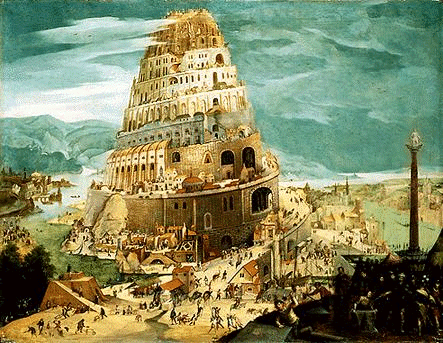
Disturbing Complacency has caused me to think about the Tower of Babel today.

These people started to build a tower to the heavens because they were afraid of being scattered around the earth. Out of fear, they stoped trusting God and instead looked for security in fame and their own achievement. Their motivation all along is self preservation of their own values.

‘When a nation’s values displaces God’s values, that nation has stolen the rightful place belonging to God.’ (Disturbing Complacency)

Out of fear, how has our nation stolen the rightful place of God?
Out of fear, how have I, in my life, stolen the rightful place of God?

I guess I find the answer by looking at my life and asking myself
‘where am I acting like God?’

Advent 11 ‘miss-giving?’

The Wednesday reflection during Advent is always about money. Today in particular my thoughts have focussed on how the west demands third world countries to restructure to receive aid. As many have became aware through initiatives like Make Poverty History, this restructuring does more than harm the country, it enables the rich western capitalism machine to continue to grow nd gain momentum while our poorer, hungrier, colder brothers and sisters become penniless, starving and dead.

We can help in these situations. We can give. We can campaign. We can purchase wisely and ethically.

Do we carefully give only what we will not miss, while we happily admire the widow who throws in her last two coins?

As Christmas gets closer, I feel uncomfortable today about how I use my money.

Advent 10 who is my God?

‘If we buy a Bible and claim it ‘mine’, we claim ownership and with ownership comes the belied that we can do what we like with what we own’ says todays Advent thought.

I have been mulling over the accuracy of this statement throughout the day. It is true that we can use the Bible to say what we wish it to say. Indeed in the past, and even currently, the Bible has been used to justify sexism, abuse of a marital partner or child, refusal of medicine or birth control, condemnation of sexuality.

I remember earlier in the year I had the privilege of being part of the congregation in Westminster Abbey at a service to commemorate the end of the slave trade. One of the the things I find most shocking about that horrible abuse of humanity is that mainstream church and government were able to justify such a trade by using the Bible.

That is shocking!
It’s hard to believe how they read that from the words on those pages.
It’s hard to believe how they could think a Jesus of compassion, love, with a preferential for the poor, would ever condone such an act.
But they did.

As I sat in Westminster Abbey I began to wonder how the Christians for the future would view us. What would they be amazed by? What would they be shocked by? Would they look back on us and ask ‘how on earth did they allow that to happen and justify it with the Bible?’

Do we use the Bible to oppress, or do we use the Bible to liberate?
asks Bodenheim. The problem is if we let the Bible be the only voice of God we hear we limit God again. The Bible is what God has said in the past and it is important for today, but God also continues to speak today and indeed for the future. Listening to just one aspect of God’s voice allows the abuses of history to repeat themselves and occur in our age.

If the Bible does not point us toward God, but instead speaks for God, then it has become our god. (Bodenheim)

Advent 9: creative expressions

‘To know the creator, we need only to look at the things he has created. The way to learn about God is through the letters of scripture and through the species of creation. We should listen to these expressions of God and conceive of their meaning in our souls’ John Scotus Eriugena (quoted in Disturbing Complacency)

To grow in understanding of god, we need to listen to the word and listen to the creation, to look at the word and look at the creation, to become involved in the word and become involved in the creation. Passivity will not bring us to a point of greater understanding; there is a need to be proactive here.

Today I went for a walk and tried to sense God in creation:
I felt the cold wind
and remembered that sometimes God has a sharp word for me
I felt the rain
I saw a worm burrowing into unseen territory
and was amazed by how little I know
and remembered those times when God has refreshed me
I saw the rushing clouds
and felt God tell me it’s ok to rush sometimes
I touched the tall steady tree seemingly unaffected by the wind
and was reminded that there is also a reason to grow slow
I touched the bare plants
and heard God say he is a God of seasons
I observed two magpies playing on the breeze
and understood that humanity is created for relationship
I observed the stretching, climbing, covering wisteria
and acknowledged how much I need to be covered in God
I saw the silver birch
and to my mind came the gifts of gold, frankincense and myrrh
I returned
and sat with my cup of tea
gazing some more on creation
and heard the ancient echo from God
‘He looked over all he had made
and saw that it was very good’