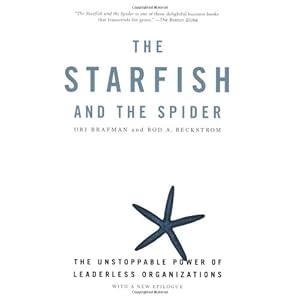
 I have recently finished reading the Starfish and the Spider. Lots of people have been surprised as I have been reading this in public as people assumed it must be a theology book (something about dog collars and being interested in nothing else?) but have been intrigued to learn it is a business book. In fact one of the freviews on the back cover boldly claims ‘one of the 10 best business books of the year’.
I have been reading this as the sub heading grabbed my attention; ‘the unstoppable power of leaderless organisations’. The back cover elaborates, ‘if you cut off a spiders head, it dies; but if you cut off a starfish’s leg it grows a new one, and that leg can grow into an entirely new starfish. Traditional top down organsiations are like spiders, but now starfish organsiations are changing the face of business and the world.
I was grabbed with the idea of starfish organisations being able to change the face of the world because, after all, isn’t that what Jesus came to do? I can’t believe the plan was to leave the church as many know it now – that hierarchical, out of touch, exclusive religious mass that is all too common and what many of us seem to have fallen into. Even if we have not, it is the image that a lot of people I meet seem to have of ‘church’.
I had never really thought about this but a starfish does not have a head. It’s central body is not even in charge and the major organs are replicated through each arm. If you cut it in half it will not die and soon you will have two starfish! Some types of starfish can replicate themselves from a piece of an arm – so you could cut it into, say, 30 pieces and soon you would have 30 starfish!
The starfish can do this because essentially it functions as a decentralised network – to even move one of the arms must convince the others that it is a good idea to do so! There is no central command and yet the starfish lives, replicates and adapts to its environments quickly and with skill. As there is no central command, but rather each leg has everything it needs to flourish, then it is not easily destroyed.
Wouldn’t it be great of the church could work like that? A church that is decentralised, that has the freedom and ability to re-grow wherever it needs to re-grow so that it looks and acts however oi needs to look and act in a certain environment amongst certain needs.
I’m not really sure where this thinking is leading me yet – and I hear the cry of ‘yes but ….’ with fears like correct doctrine, making decisions, and so on; but I also see the massive plus here for mission – and by that I mean being good news, responding to local need quickly, honestly and compassionately.
The idea of leaderless church attracts me. Essentially we have a leader – on this occasion the correct answer is Jesus. So, is there a need for a sole human leader as well? Would not a starfish mentality be better than a spider mentality as far as church is concerned? Could then the church respond with compassion in integrity rather than become embroiled in stuff which many see as a distraction from our calling and mission.
It’s an interesting thought – and the book is worth a read too!

 The Shiny Headed Prophet
Hi Rob,I read this last year during a sabbatical. If you search my blog for tags relating to Ori Brafman or Rod Beckstrom, you'll find a series of posts where I offered quick, off the cuff, preliminary (and otherwise provisional!) thoughts on relationships to mission. I think it's a fantastic book and thousands of Christians should read it for the implications in how we are church today.
Hi, while I was at St Thomas Pilgrimage event a couple of weeks ago, this book was mentioned a few times by different speakers. It has been influential in Sheffield in terms of the development of missional communities and particularly around the 'high accountability/low control' method of Jesus/church planting…resonates hugely with everything we're doing at the mo – so it's on my Amazon wishlist! Thanks for your comments..I'll put it on the reading list for August after all the youth events and summer camps are over!Blessings x